Je n’ ai pas eu à hésiter longtemps : l’ environnement dynamique de la maison d’ édition medinfo et la conception de ses revues par des médecins pour des médecins – attrayants et professionnels – me donnent la possibilité de pouvoir promouvoir la qualité de ces revues de formation médicale en tant que directeur médical, en exerçant une activité à temps partiel. Après la mise en place du Forum Médical Suisse et plus de cinq ans en tant que rédacteur de la rubrique « Sans détour », je me réjouis de pouvoir continuer à m’ adonner à mon passe-temps si passionnant – l’ interprétation de la littérature tout autour de la médecine – avec la nouvelle rubrique « Reto Krapfs Medical Voice ». Cela me permet de continuer à mettre mon expérience clinique et rédactionnelle au service de la formation médicale et de contribuer au concept medinfo d’ une formation continue de qualité de première main.
Lors de la lecture de cette nouvelle rubrique, quelques informations supplémentaires concernant son auteur peuvent également être utiles : Je travaille à plein temps en tant que directeur médical («chief medical officer») pour l’entreprise des laboratoires SYNLAB à vocation internationale. En tant que médecin spécialiste en médecine interne générale et néphrologue, j’ai travaillé principalement en hôpital et je me suis consacré, dans le cadre de mes recherches et de l’ enseignement, aux mécanismes physiologiques et pathophysiologiques de l’organisme sain et malade.
Au sein de medinfo, la nouvelle rubrique, bien que traditionnelle, me semble d’ autant plus intéressante qu’ elle permet d’atteindre non seulement la Suisse allemande via la revue « der informierte arzt » mais aussi la Suisse romande via la « gazette médicale ». Au-delà de la formation continue de médecins généralistes, je suis content de pouvoir fournir des informations en médecine générale aussi à des spécialistes d’autres disciplines via « info@onco-suisse » et « info@gynécologie ». De nouvelles idées créatives et innovatives pour la présentation « sur papier » et « en ligne » du contenu des revues de medinfo sont déjà en discussion, de sorte qu’une phase passionnante a également commencé dans ce domaine, visant à pouvoir mettre à votre disposition, chers lectrices et lecteurs, un service encore meilleur.
J’espère que l’année 2023 a bien commencé pour vous et qu’elle se poursuivra ainsi. Je me réjouis beaucoup de la collaboration au sein de la maison d’édition, avec mes collègues médecins dans les rédactions et – bien sûr – avec vous, chers lectrices et lecteurs des revues de medinfo.
Il ne me reste plus qu’ à vous/nous souhaiter une bonne « année medinfo » !
Quelle anticoagulation orale chez les personnes de plus de 80 ans souffrant de thromboembolies veineuses ?
Dans de nombreux domaines de la médecine, les individus âgés sont sous-représentés dans les études cliniques évaluant l’ efficacité et la sécurité en médecine, y compris dans le traitement des thromboembolies veineuses. Ce groupe d’ individus a un risque élevé de thromboembolies récidivantes, de mortalité, mais aussi d’ effets secondaires liés aux hémorragies, ce qui explique l’ importance des informations sur l’ anticoagulation la plus efficace et la plus sûre. Dans une étude canado-allemande portant sur plus de 6700 patients âgés en moyenne de près de 85 ans et souffrant de thromboembolies veineuses, les anticoagulants oraux directs se sont avérés aussi efficaces et sûrs que les antagonistes de la vitamine K plus traditionnels en ce qui concerne les critères d’ évaluation mentionnés (suivi de près de 6 mois), mais pas meilleurs non plus. Le rivaroxaban (60%) et l’ apixaban (un peu plus de 30%) étaient les anticoagulants directs les plus utilisés. Les deux groupes étaient assez comparables concernant les comorbidités (y compris les néoplasies) et les médicaments préexistants. Vous et vos patients avez donc le choix ! Pour des raisons de convenance, les anticoagulants oraux directs devraient souvent être privilégiés (également) dans ce groupe.
Am J Medicine 2022, doi.org/10.1016/j.amjmed.2022.08.033
Seule la mesure est parfaite
L’ Entraînement optimal pour la promotion de la santé
Selon les études menées jusqu’ à présent, l’ entraînement d’ endurance est associé à une réduction du risque de maladie cardiovasculaire, voire de décès, en fonction de la dose. Les observations de la vie quotidienne peuvent cependant facilement convaincre chacun d’ entre nous qu’ il y a de plus en plus de personnes, même âgées, qui s’ entraînent de plus en plus intensément et qui s’ exposent ainsi à un potentiel de dépendance. Il n’ est pas certain que tout cela soit sans danger. La troponine ultrasensible augmente en tout cas après un effort d’ endurance intense et est considérée dans un autre contexte comme spécifique d’ une atteinte myocardique. Une surcharge ventriculaire droite aiguë peut également survenir. Des associations à long terme avec un entraînement physique encore plus intense existent pour la fibrillation auriculaire, la fibrose myocardique, les dilatations de l’ aorte ascendante et l’ augmentation du score calcique coronaire (appelé CAC, Coronary Artery Calcification). Il s’ agit d’ associations, et non de relations de cause à effet. Les effets à long terme dus à des entraînements plus intenses méritent toutefois d’ être pris en considération. Peut-être qu’ un entraînement optimal pour la promotion de la santé peut être exagéré, au détriment de l’ individu concerné. Dans le cas des plaques coronaires calcifiées des sportifs, leur stabilité semble améliorée par le processus de calcification. Donc plus de plaques, mais plus stables : rassurant ?
NEJM Evidence 2022, doi.org/10.1056/EVIDra2200175
Quel diagnostic poseriez-vous ?
Fatigue et irritabilité accompagnées d’ une prise de poids
Une jeune femme de 21 ans, non fumeuse, avec une contraception efficace et une hypothyroïdie bien traitée, se plaint de fatigue, d’ irritabilité, de douleurs abdominales sourdes presque quotidiennes, donc indépendantes des règles, et d’ une prise de poids d’ au moins 4 kg au cours des 4 derniers mois. Elle est normotendue, l’ examen clinique ainsi que le « laboratoire de routine » ne montrent pas d’ anomalies. Les examens d’ imagerie dévoilent une tumeur surrénale droite de plus de 4 cm de diamètre. Le taux de cortisol urinaire sur 24h est normal, tout comme les catécholamines et la rénine, ainsi que l’ aldostérone et les androgènes surrénaliens. L’ ACTH (corticostimuline) dans le sang est diminuée. Après l’ administration orale de 1 mg de dexaméthasone à 23 heures, le taux de cortisol dans le sang n’ est pas totalement normalisé le lendemain matin, ce qui devrait être le cas en temps normal.
Ma supposition la plus probable (plus d’ une réponse peut être correcte) :
1 une métastase d’ une tumeur pulmonaire 2 un syndrome de Cushing subclinique 3 un adénome surrénalien (« incidentalome ») 4 un carcinome corticosurrénalien
Réponses : un carcinome pulmonaire métastatique est très rare à cet âge en l’ absence de facteur de risque principal, malgré la prédisposition aux métastases de la corticosurrénale. Une masse tumorale aussi importante est suspecte d’ un carcinome surrénalien (en soi également rare). Une ACTH supprimée en l’ absence de signes d’ hypercortisolisme (sécrétion normale de cortisol sur 24h) est compatible avec un syndrome de Cushing subclinique. L’ absence de suppression du cortisol plasmatique endogène après administration d’ un glucocorticoïde synthétique exogène, la dexaméthasone, le prouve. La constellation est donc comparable à l’ hyperthyroïdie subclinique qui vous est probablement plus familière (TSH supprimée, T3/T4 – encore – normales ou seulement légèrement élevées). Malheureusement, le diagnostic d’ un carcinome surrénalien avec un syndrome de Cushing subclinique s’ est avéré exact. Les réponses 2 et 4 sont donc correctes.
NEJM 2022, doi:10.1056/NEJMcpc2201250
Domaines touchant la médecine
Avantages de la ménopause
La plupart des mammifères ne connaissent pas la ménopause au sens strict du terme. Outre l’ homme, les orques (« épaulards ») et parfois les éléphants constituent des exceptions notables. Ces deux espèces se caractérisent par une progéniture qui grandit très lentement et qui dépend de la protection maternelle pendant de nombreuses années. Le prix, pour ainsi dire, à payer pour avoir des enfants est donc assez élevé pour les mères (les femmes et les femelles orques). Une interprétation plausible de différentes observations est que, chez ces espèces, les membres féminins sont libérés de l’ obligation d’ avoir des enfants et de les élever eux-mêmes par la suspension de la fertilité, ce qui leur permet de ne plus concentrer leur expérience, leur intelligence et, oui, leur rôle de leader uniquement sur leurs propres enfants, mais de l’ étendre à tout un groupe. Cela est probablement d’ une grande importance pour le développement, les capacités d’ apprentissage du groupe/de la famille, la transmission des connaissances et la survie de l’ espèce.
Lucy Cooke «Bitch. A revolutionary guide to sex, evolution and the female animal», Penguin Random House UK, 2022
Qu’ est-ce qui nous attend ?
Nouveaux variants d’ Omicron avec évasion immunitaire
En ce moment, on trouve dans presque tous les journaux une rétrospective de 2022 avec les informations médicales les plus importantes de l’ année passée, mais l’ anticipation de 2023 vaudrait bien la peine. Sur le plan infectiologique, vous êtes probablement occupés en premier lieu par des cas de grippe saisonnière (Influenza A) et de VRS au cabinet médical. Mais le SRAS-CoV-2 pourrait bientôt nous occuper à nouveau de manière accrue : Le sous- variant Omicron BA.5 est toujours dominant, mais plusieurs autres variants ont évolué à partir de celui-ci (ont continué à muter). Les chercheurs du SRAS-CoV-2 parlent désormais d’ une « soupe de variants » d’ Omicron. Deux des variants sont particulièrement désagréables, car les personnes vaccinées ou ayant déjà contracté la maladie présentent des taux d’ anticorps extrêmement faibles contre ces variants. De plus, les anticorps monoclonaux efficaces contre Omicron semblent inefficaces contre ces deux variants (appelés BQ et XBB).
Cell 2022, doi.org/10.1016/j.cell.2022.12.018
En moins d’ une demi-minute….
Qu’ est-ce qu’ une « biopsie liquide » ?
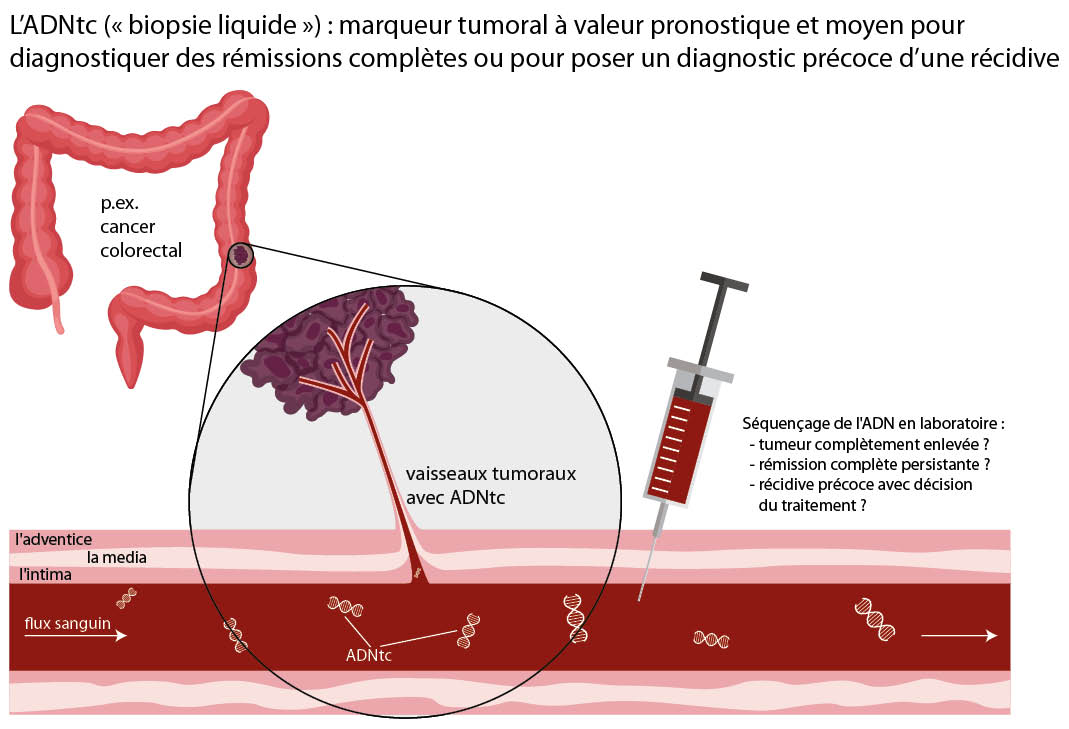
Une « biopsie liquide » (liquid biopsy) est la mise en évidence, basée sur la biologie moléculaire, d’ ADN circulant dans le sang et provenant d’ une tumeur (circulating tumor DNA – ctDNA – ADNtc, voir figure 2). Il existe également de l’ ADN circulant non tumoral, appelé ADN circulant bénin, dans toute une série de lésions organiques, par exemple l’ ADN myocardique après un infarctus du myocarde. Des méthodes de détection de plus en plus précises ainsi que de séquençage de l’ ADN extrêmement étendues et rapides (« next generation sequencing », NGS) pour détecter les mutations de l’ ADN tumoral ont ouvert à juste titre un nouveau chapitre diagnostique et thérapeutique en oncologie (1).
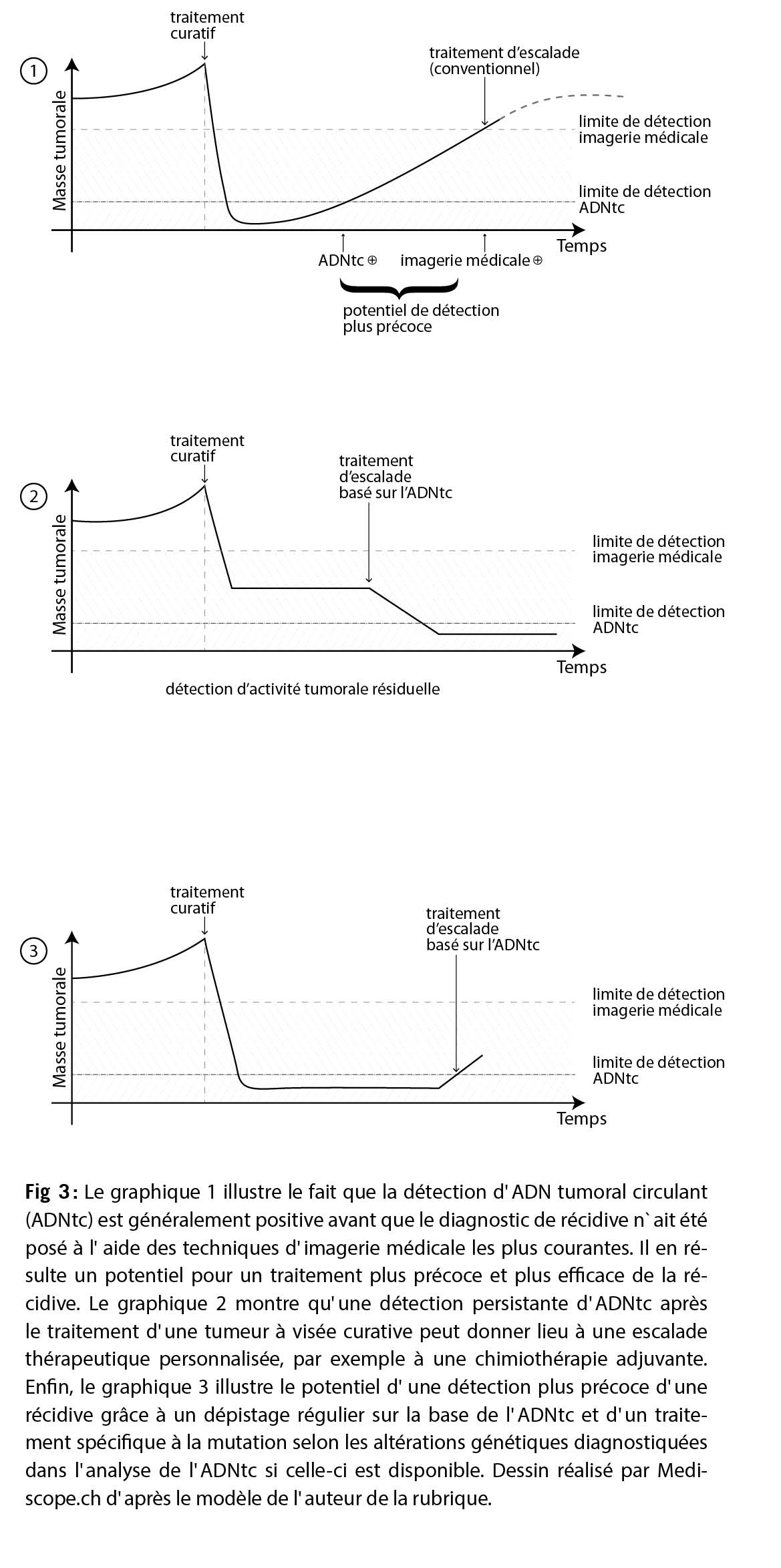
La figure 3 présente quelques possibilités de la « méthodologie ADNtc », notamment la documentation d’ une rémission complète ou seulement partielle et – on l’ espère – d’ un diagnostic plus précoce d’ une récidive avec par conséquent un meilleur pronostic. Pour certains stades du cancer colorectal, il a été démontré que les patients sans détection postopératoire d’ ADNtc pouvaient être épargnés de la chimiothérapie adjuvante. Ils n’ avaient pas de désavantage par rapport au pronostic, en comparaison avec le groupe de contrôle dans lequel de l’ ADNtc avait été détecté, ce qui nécessitait une chimiothérapie adjuvante (3). La détection d’ ADNtc doit également être envisagée en cas de biopsie tissulaire tumorale difficile ou dangereuse et peut présenter d’ autres avantages diagnostiques par rapport à celle-ci : Il y a moins de problèmes avec les « sampling errors », c’ est-à-dire lorsque la biopsie n’ est pas représentative de l’ ensemble de la tumeur. Bien que les progrès technologiques mentionnés aient réduit la probabilité de faux négatifs, il en existe toujours et le taux de faux négatifs doit être évalué pour chaque méthode et chaque type de tumeur. Outre l’ ADNtc, l’ ARN circulant provenant de la tumeur, les cellules tumorales circulantes elles-mêmes et les membranes de cellules tumorales circulantes (vésicules extracellulaires) sont également en cours d’ évaluation clinique en tant que biomarqueurs.
1. Nature Medicine 2022 doi.org/10.1038/s41591-022-02068-8, 2. NEJM 2022, DOI: 10.1056/NEJMoa2200075
Le dépistage précoce du cancer de la prostate a longtemps été controversé en raison des craintes justifiées de surdiagnostic et de surtraitement. Les données à long terme des études internationales les plus importantes ont pu montrer que le dépistage par dosage du PSA peut réduire efficacement la mortalité due au cancer de la prostate, si bien que la Commission européenne a recommandé récemment l’ introduction de programmes de dépistage nationaux. Grâce à l’ imagerie par résonance magnétique multiparamétrique (IRM) de la prostate permet de réduire le nombre de biopsies inutiles et d’ augmenter le taux de détection des tumeurs cliniquement significatives.
Prostate cancer screening has long been controversial due to legitimate concerns about overdiagnosis and overtreatment. Long-term data from the largest international studies have shown that PSA-guided screening can effectively reduce prostate cancer mortality, and the European Commission has recently recommended the introduction of national screening programs. The multiparametric magnetic resonance imaging (MRI) of the prostate can reduce the number of unnecessary biopsies and simultaneously increased the detection of clinically significant prostate tumours. Key Words: PSA, Prostate Cancer, Screening, Preventive Medicine
Le cancer de la prostate est le cancer le plus fréquent chez les hommes et la deuxième cause de mortalité liée au cancer en Suisse. Depuis le début des années 1990, le dépistage du cancer de la prostate est possible grâce à la détermination de l’ antigène prostatique spécifique (PSA) dans le sérum (test PSA). Dans le même temps, la mortalité due au cancer de la prostate a diminué dans la plupart des pays occidentaux (1), mais l’ utilité du dépistage de ce cancer a longtemps été controversée en raison des risques associés au diagnostic invasif et du risque de surtraitement des cancers de la prostate non pertinents sur le plan clinique (2, 3). En 2012, le groupe de travail des services préventifs des États-Unis (US Preventive Services Task Force, USPSTF) a publié une recommandation déconseillant le dépistage par dosage du PSA (4). A la même époque, le rôle du dépistage basé sur le PSA a fait l’ objet d’ un débat tout aussi intense en Suisse, avec des recommandations divergentes du Swiss Medical Board et de la Société suisse d’ urologie (5, 6). Depuis, les données à long terme de l’ importante étude européenne « European Randomized Study of Screening for Prostate Cancer » (ERSPC) ont été publiées et ont démontré une réduction significative de la mortalité associée au cancer de la prostate grâce au dépistage par dosage du PSA (7). Ces données ont été en partie déterminantes pour le changement de la recommandation de l’ USPSTF en 2017, vers un processus de prise de décision individuel relatif au dépistage à l’ aide du PSA chez les hommes âgés de 55 à 69 ans.
L’ importance du dépistage du cancer de la prostate a été soulignée récemment (le 20 septembre 2022) par la Commission européenne, qui a recommandé de promouvoir ce dépistage chez les hommes de moins de 70 ans (8). L’ article suivant aborde plus en détail les recommandations actuelles en matière de dépistage du cancer de la prostate.
Le dépistage
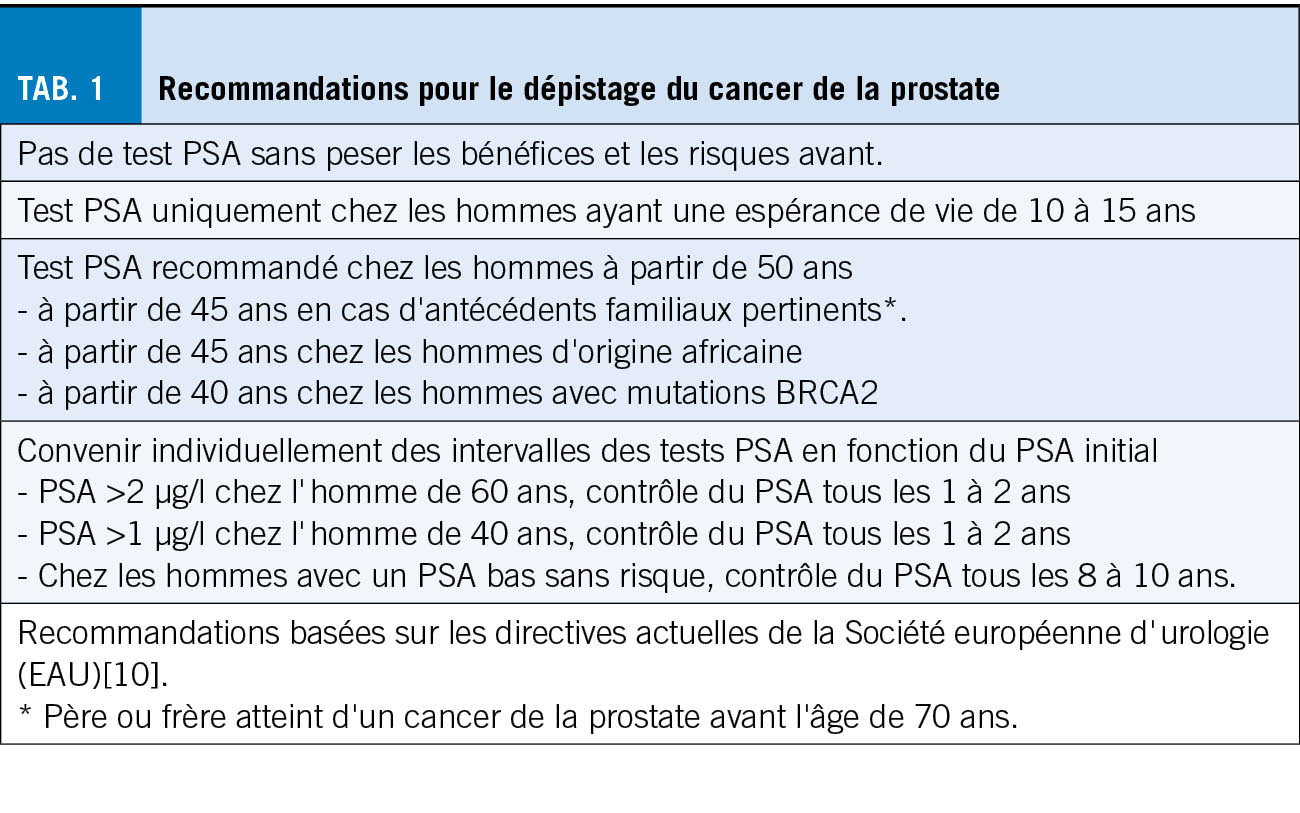
Les objectifs primaires du dépistage du cancer de la prostate sont la réduction de la mortalité ainsi que le maintien de la qualité de vie. Conformément aux recommandations de l’ Association Européenne d’ Urologie (EAU), il est recommandé de commencer le dépistage du cancer de la prostate dès l’ âge de 50 ans. En cas de risque accru, un dépistage est recommandé à partir de 45 ans, notamment pour les hommes ayant des antécédents familiaux positifs pertinents (père ou frère atteint d’ un cancer de la prostate avant l’ âge de 70 ans) et les hommes d’ origine africaine. Chez les hommes porteurs d’ une mutation BRCA2, le dépistage est recommandé dès l’ âge de 40 ans (tableau 1). Le carcinome de la prostate étant une tumeur maligne qui se développe lentement, le dépistage n’ est recommandé que si l’ espérance de vie restante est d’ au moins 10 à 15 ans. C’ est pourquoi la limite supérieure de 70 ans est souvent mentionnée dans la littérature, bien qu’ il soit judicieux de repousser le dépistage pour les patients plus jeunes d’ un point de vue biologique ou en très bonne santé. Inversement, chez les patients plus jeunes présentant des comorbidités importantes, il convient également de renoncer à un dosage du PSA après une évaluation appropriée (ce que l’ on appelle les « competing risks »). Ces réflexions devraient avoir lieu idéalement avant un dosage du PSA, afin d’ éviter des tests superflus ainsi que des traitements inutiles.
Le cancer de la prostate
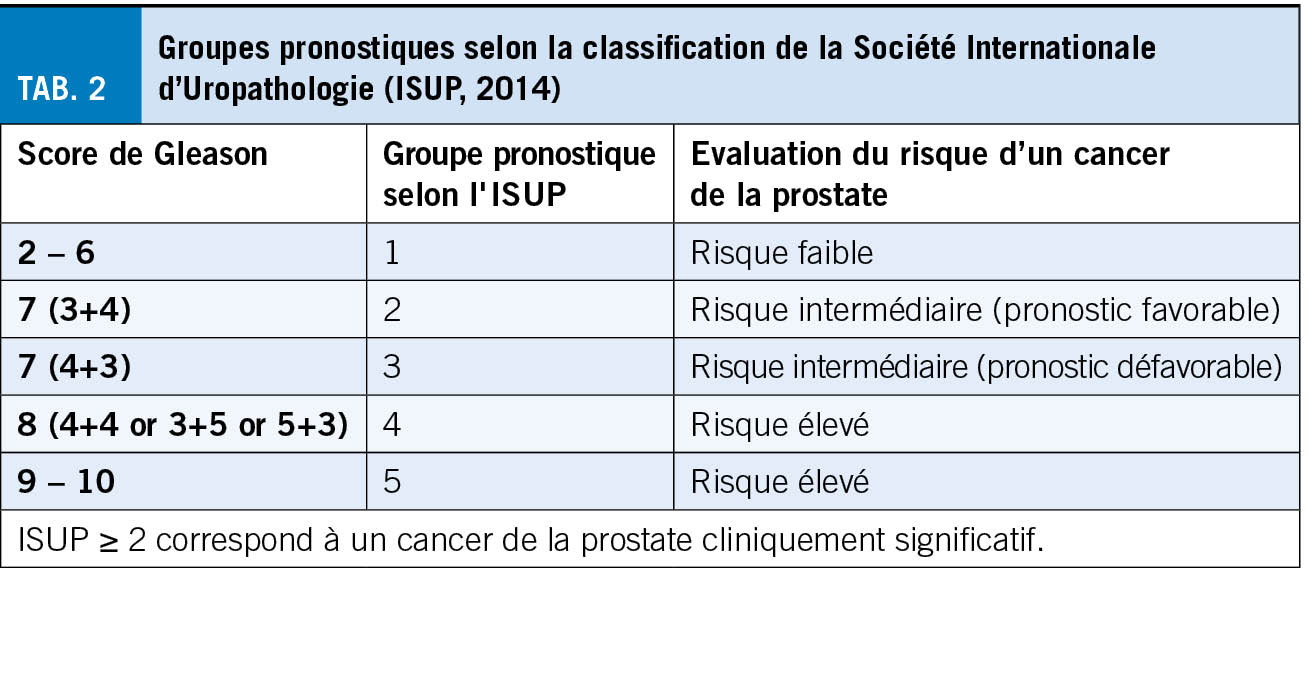
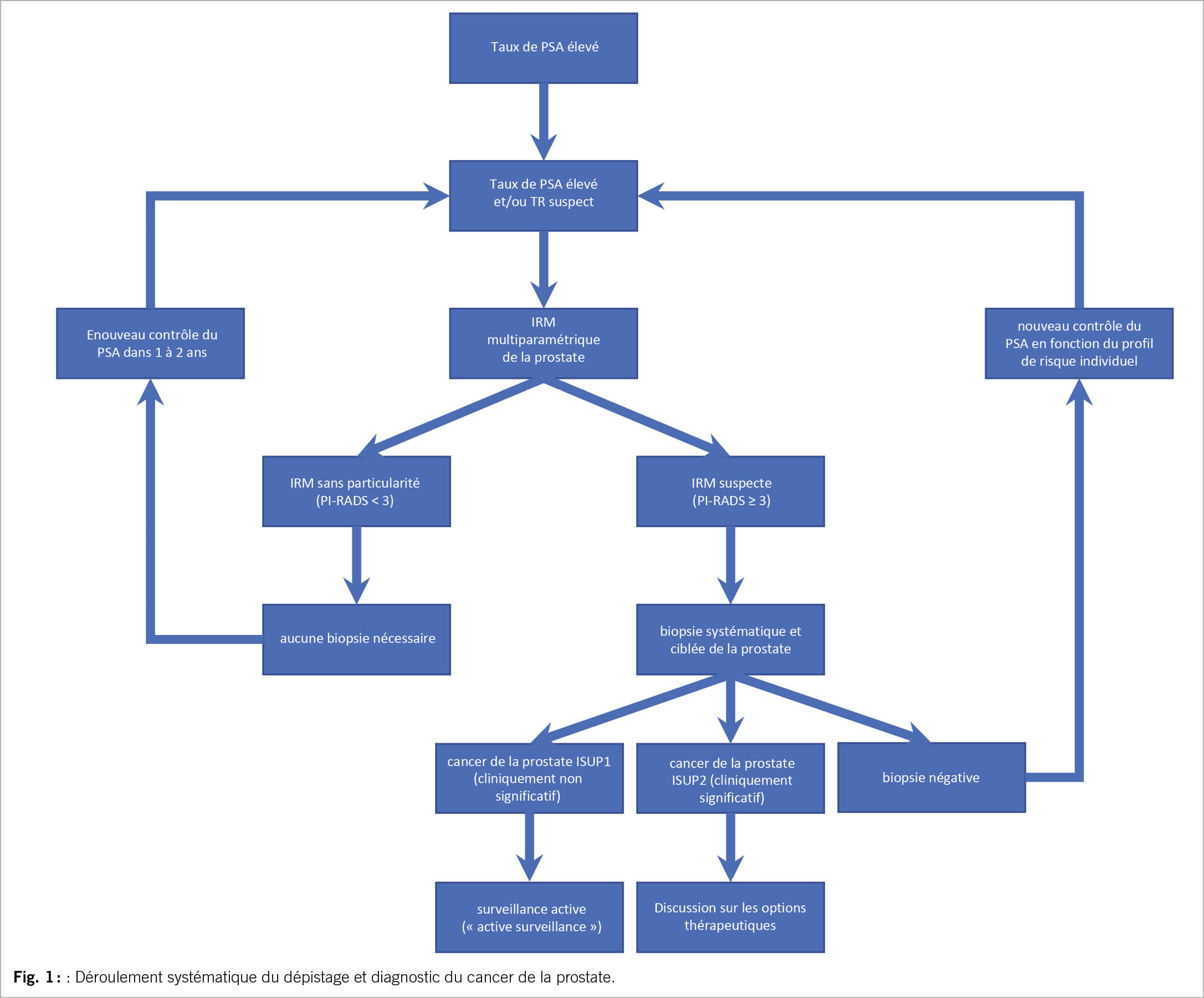
Un taux de PSA élevé, un toucher rectal (TR) suspect ou une imagerie par résonance magnétique (IRM) anormale de la prostate conditionnent une biopsie. De multiples prélèvements du tissu de la prostate sont alors effectués et envoyés pour une analyse histopathologique. En cas de détection d’ un carcinome, celui-ci est classé selon la classification de la Société Internationale d’ Uropathologie (ISUP) par grades de 1 à 5, ce qui remplace l’ ancien score de Gleason. ISUP1 correspond à un cancer de la prostate avec score de Gleason 3+3=6, classé « cancer de la prostate à faible risque » (tableau 2). Pour une grande majorité des cancers de la prostate ISUP 1, une surveillance active suffit, ce qui permet aux patients d’ éviter les effets secondaires risqués d’ un traitement curatif.
Les cancers de la prostate ISUP 2 et plus sont considérés comme des « cancers de la prostate cliniquement significatifs », pour lesquels un traitement actif est souvent indiqué. (Certes, les patients avec des tumeurs ISUP 2, strictement sélectionnés, peuvent également être pris en charge avec succès par une surveillance active (9), mais la majorité des patients doivent être traités de manière curative (10).)
Le PSA
Le PSA (l’antigène spécifique de la prostate) est une peptidase qui est produite exclusivement dans les cellules épithéliales de la prostate (cellules glandulaires). On peut le détecter en grande quantité dans l’éjaculat et, en faibles concentrations, également dans le sang. Le PSA dilue l’éjaculat et soutient la motilité des spermatozoïdes. Dans le sang, le PSA n’a aucune fonction. La première description du PSA a eu lieu en 1979 (11), et la première description pour l’utilisation dans le dépistage du cancer de la prostate a été faite en 1991 (12). Comme le PSA n’est pas spécifique de la tumeur, mais un biomarqueur spécifique à l’organe, le taux de PSA peut être élevé non seulement dans le cadre d’un cancer de la prostate, mais également en cas d’hypertrophie bénigne de la prostate (hyperplasie bénigne de la prostate [HBP]), d’une inflammation de la prostate (souvent subclinique), après une activité sexuelle, ainsi que par une pression exercée sur le périnée (par exemple en faisant du vélo). La probabilité d’un cancer de la prostate augmente avec le PSA, mais il n’existe pas de valeur standard universelle du taux de PSA (13). Il augmente avec l’âge de sorte que les valeurs de PSA considérées «normales» sont adaptées à l’âge (p. ex. taux limite de PSA de 2.5 μg/l pour les hommes âgés de 40 – 49 ans, et de 6.5 μg/l pour les hommes âgés de 70 à 79 ans) (14). En cas de taux de PSA élevé, il est toujours recommandé de procéder à un deuxième dosage de PSA. De plus, il est conseillé de s’abstenir de toute activité sexuelle et de ne pas faire du vélo pendant les 37 jours qui précèdent l’examen, afin d’exclure tout impact possible sur le taux de PSA. Dans notre clinique, nous parlons d’un „taux de PSA élevé“ en cas de détection répétée d’un taux supérieur à 3,0 μg/l (pour les hommes jusqu’à 50 ans : 2,5 μg/l), et recommandons de procéder à un examen plus approfondi.
Il convient en outre de mentionner la densité du PSA (PSAD), qui se calcule sur la base du taux de PSA et du volume de la prostate. Le risque de cancer de la prostate cliniquement significatif augmente avec un taux de PSAD croissant, à l’inverse il est moindre en cas de PSAD en baisse (4% de risque de cancer de la prostate cliniquement significatif avec un PSAD <0,09 μg/l/cc) (15).
Le toucher rectal
Historiquement, 18% de tous les cancers de la prostate ont été diagnostiqués seulement sur la base du toucher rectal (TR), indépendamment de la valeur du PSA (16). La valeur prédictive positive d’un TR suspect en cas d’un taux de PSA <4 μg/l est de 5 – 30% (PSA 0 – 1,0 μg/l : 5% ; PSA 1,1 – 2,5 μg/l : 14% ; PSA 2,6 – 4,0 μg/l : 30%) (17). Les données de l’ERSPC montrent que la probabilité de détection d’un cancer est doublée chez les hommes présentant un taux de PSA élevé et un TR suspect, par rapport à un taux de PSA élevé sans TR (48,6% vs 22,4%) (18). En cas de TR suspect de la prostate, il est recommandé, indépendamment du taux de PSA, d’envoyer le patient chez un urologue pour une nouvelle évaluation clinique plus approfondie, aussi à l’aide d’une IRM multiparamétrique.
Imagerie par résonance magnétique (IRM) de la prostate
L’introduction de l’IRM multiparamétrique de la prostate a révolutionné le diagnostic du cancer de la prostate au cours de la dernière décennie. L’évaluation de différentes séquences permet de classer les lésions suspectes de la prostate selon la classification „Prostate Imaging Reporting and Data System“ (PIRADS). L’échelle va de 1 (cancer de la prostate très improbable) à 5 (cancer de la prostate très probable). Dans la pratique, il est recommandé de faire une biopsie des lésions PIRADS 3 et plus. Mais en cas de PSAD faible, il est possible de renoncer à une biopsie des lésions PIRADS 3 dans certaines situations (10). Cette sélection permet de réduire le nombre de biopsies de plus de 30%, sans pour autant diminuer le taux de détection des cancers de la prostate cliniquement significatifs (19). Selon une méta-analyse Cochrane, l’IRM a démontré par rapport aux biopsies de saturation (>20 biopsies), une sensibilité en commun de 0,91 (IC à 95 % : 0,83 0,95) et une spécificité en commun de 0,37 (IC à 95 % : 0,290,46) pour les cancers de la prostate cliniquement significatifs (ISUP≥2) (20). L’IRM est moins sensible pour la détection des carcinomes de la prostate ISUP 1 (21), ce qui est en fait voulu, car ces carcinomes ne nécessitent normalement pas de traitement. Cette imagerie aide non seulement à décider si une biopsie de la prostate est nécessaire, mais également à fournir des informations sur la dimension spatiale qui aident pour la biopsie ultérieure et du traitement si nécessaire.
Biopsie de la prostate
De manière classique, la biopsie de la prostate s’effectuait par échographie transrectale (ETR) et prélèvement transrectal de 12 fragments de prostate (biopsie dite „systématique“). Cette intervention peut provoquer, entre autres, une hémospermie, une hématurie ou une rétention urinaire. En outre, malgré une désinfection locale et une antibiothérapie préventive, une infection post-interventionnelle peut se produire dans jusqu’à 3% des cas.
Des infections des voies urinaires ainsi qu’une uro-septicémie peuvent également se développer (22), ce qui constitue un problème majeur en raison de la résistance croissante d’E. coli aux antibiotiques. Pour réduire le taux d’infection, il est donc recommandé de faire les biopsies par voie transpérinéale dans la mesure du possible. La sécurité du diagnostic est la même que pour la biopsie transrectale, avec un risque nettement plus faible d’infection des voies urinaires.
Comme mentionné précédemment, l’IRM permet d’identifier des zones suspectes dans la prostate. Pour pouvoir biopsier ces lésions de manière ciblée, il existe aujourd’hui diverses possibilités de fusionner l’IRM et les images de l’ETR, par exemple avec des appareils spécialisés (p. ex. Artemis ou BiopSee), ou par fusion cognitive. Cela permet de prélever des „biopsies ciblées“ des lésions suspectes, ce qui entraîne un taux de détection nettement plus élevé des cancers de la prostate cliniquement significatifs (ISUP≥2). L’EAU recommande donc la réalisation simultanée d’une biopsie systématique et ciblée de la prostate dès la première biopsie (10).
Biomarqueurs
En raison du manque de spécificité du PSA, plusieurs biomarqueurs sanguins, urinaires et tissulaires ont été développés au cours des trois dernières décennies. Ces biomarqueurs utilisent souvent des variables cliniques (par exemple le volume de la prostate ou l’âge du patient) et peuvent aider à évaluer la nécessité d’une biopsie de la prostate afin d’éviter un surdiagnostic et un surtraitement (23). Jusqu’à présent, l’utilisation de ces biomarqueurs n’est pas encore largement répandue en Suisse. Les raisons possibles sont le coût parfois élevé des tests, le manque de disponibilité ou le manque de prise en charge par les caisses d’assurance-maladie. Actuellement, l’utilisation de biomarqueurs n’est pas encore recommandée pour le dépistage de routine (10). Ils peuvent toutefois être très utiles pour certains patients, comme c’est le cas par exemple pour le SelectMDx® chez les patients qui ne peuvent pas être examinés par IRM (claustrophobie ou artefacts de prothèses de hanche) (24).
Le PSA libre est l’un des rares biomarqueurs à être largement utilisé. En combinaison avec le PSA total, il peut être utile pour évaluer le risque. En raison de l’instabilité relative du PSA libre, l’utilisation du rapport PSA libre/total n’est que partiellement recommandée (10). Une option plus récente, également disponible en Suisse, est l’utilisation du Proclarix® Risk Score. Ce test sanguin inclut non seulement l’âge du patient, le PSA et le PSA libre, mais aussi deux autres protéines. Il a été démontré qu’il permet de réduire le nombre de biopsies nécessaires (25).
Calculateurs de risque
Il existe différents calculateurs de risque qui permettent d’estimer le risque individuel de cancer de la prostate à l’aide de paramètres cliniques (notamment l’âge, le TR et le taux de PSA) basés sur de grandes cohortes (par exemple, la cohorte ERSPC (26)). Le facteur prédictif le plus fort dans les calculateurs de risque est la PSAD (10).
Les calculateurs de risque sont très utiles pour évaluer le risque individuel d’un patient et peuvent aider à éviter des biopsies inutiles (27).
Risques associés au dépistage du cancer de la prostate par PSA
Les hommes doivent être informés des risques potentiels associés au dépistage de la prostate par PSA. Les risques immédiats de la mesure du PSA (prise de sang) et du TR sont faibles, mais les examens complémentaires peuvent représenter une cause de morbidité. Une biopsie peut entraîner des complications telles qu’une infection des voies urinaires, une hémorragie ou une rétention urinaire (22). En outre, des effets secondaires peuvent survenir dans le cadre du traitement d’un cancer de la prostate diagnostiqué, tels que l’incontinence urinaire, la dysfonction érectile et les douleurs, ainsi qu’une mortalité associée au traitement (28).
Résumé
La détection précoce du cancer de la prostate par le dépistage par PSA a longtemps fait l’objet de controverses. Les données à long terme de l’étude ERSPC ont entre-temps pu montrer que le dépistage par PSA permet de réduire de manière significative la mortalité associée au cancer de la prostate. L’IRM de la prostate a permis de réduire de manière significative les biopsies inutiles de la prostate et d’améliorer simultanément la sécurité du diagnostic grâce à des biopsies ciblées. De même, le risque de surtraitement des cancers de la prostate à faible risque détectés a été réduit grâce à la surveillance active largement répandue. L’organigramme ci-joint illustre le déroulement systématique partant d’un taux élevé de PSA, sur la base des recommandations de l’EAU sur le cancer de la prostate (10) (fig. 1). Le dépistage du cancer de la prostate est basé sur des preuves, la décision de procéder à un dépistage ne doit être prise qu’après avoir pris en considération les avantages ainsi que les risques potentiels.
Cet article est une traduction de « der informierte arzt » 12_2022
Copyright Aerzteverlag medinfo AG
Dr Manolis Pratsinis, MSc
médecin cadre
Clinique d’urologie, Hôpital cantonal de St-Gall
Rorschacher Strasse 95
9007 St. Gall
PD Dr Daniel Engeler, MA
Médecin-chef adjoint
Clinique d’urologie, Hôpital cantonal de St-Gall
Rorschacher Strasse 95
9007 St. Gall
Les auteurs n’ont pas déclaré de conflits d’ intérêt en rapport avec cet article.
◆ Un dépistage par TR et dosage du taux de PSA pour la détection précoce du cancer de la prostate est utile et fondé sur des données probantes.
◆ Le PSA est un biomarqueur spécifique à un organe, mais pas à une tumeur. Il peut donc être élevé également en raison d’ une hypertrophie bénigne de la prostate ou d’une inflammation de la prostate.
◆ De nouvelles technologies, telles que l’ IRM multiparamétrique ainsi que des calculateurs de risque, permettent d’ éviter des biopsies inutiles et ainsi de réduire la morbidité lors du dépistage précoce du cancer de la prostate.
1. Loeb S. Guideline of guidelines: prostate cancer screening. BJU Int. 2014;114:323-5.
2. Etzioni R, Gulati R, Cooperberg MR, Penson DM, Weiss NS, Thompson IM. Limitations of basing screening policies on screening trials: The US Preventive Services Task Force and Prostate Cancer Screening. Med Care. 2013;51:295-300.
3. Melnikow J, LeFevre M, Wilt TJ, Moyer VA. Counterpoint: Randomized trials provide the strongest evidence for clinical guidelines: The US Preventive Services Task Force and Prostate Cancer Screening. Med Care. 2013;51:301-3.
4. Moyer VA. Screening for prostate cancer: U.S. Preventive Services Task Force recommendation statement. Ann Intern Med. 2012;157:120-34.
5. Board EdSM. PSA-Test nicht geeignet zur Früherkennung des Prostatakarzinoms. Schweiz Ärztezeitung. 2011;92(48):1857.
6. Recker F ST. Messung des prostataspezifischen A ntigens (PSA-Test) zur F rüherkennung des Prostatakarzinoms Swiss Medical Board oder: «das Kind mit dem Bade ausschütten». Schweiz Ärztezeitung. 2011;92(51):2002–4
7. Hugosson J, Roobol MJ, Månsson M, Tammela TLJ, Zappa M, Nelen V, et al. A 16-yr Follow-up of the European Randomized study of Screening for Prostate Cancer. Eur Urol. 2019;76:43-51.
8. Commission E. European Health Union: A new EU approach on cancer detection – screening more and screening better. 2022.
9. Paudel R, Madan R, Qi J, Ferrante S, Cher ML, Lane BR, et al. The Use and Short-term Outcomes of Men With National Comprehensive Cancer Network Favorable Intermediate-risk Prostate Cancer Managed With Active Surveillance: The Initial Michigan Urological Surgery Improvement Collaborative Experience. Journal of Urology.0:10.1097/JU.0000000000003012.
10. Mottet N, Cornford P, van den Bergh R, De Santis M, Gillessen S, Grummet J, et al. EAU-EANM-ESTRO-ESUR-ISUP-SIOG Guidelines on Prostate Cancer. EAU Guidelines Office, Arnhem, The Netherlands; 2022.
11. Wang MC, Valenzuela LA, Murphy GP, Chu TM. Purification of a human prostate specific antigen. Invest Urol. 1979;17:159-63.
12. Catalona WJ, Smith DS, Ratliff TL, Dodds KM, Coplen DE, Yuan JJ, et al. Measurement of prostate-specific antigen in serum as a screening test for prostate cancer. N Engl J Med. 1991;324:1156-61.
13. Semjonow A, Brandt B, Oberpenning F, Roth S, Hertle L. Discordance of assay methods creates pitfalls for the interpretation of prostate-specific antigen values. Prostate Suppl. 1996;7:3-16.
14. Partin AW, Criley SR, Subong ENP, Zincke H, Walsh PC, Oesterling JE. Standard Versus Age-Specific Prostate Specific Antigen Reference Ranges Among Men With Clinically Localized Prostate Cancer: A Pathological Analysis. The Journal of Urology. 1996;155:1336-9.
15. Yusim I, Krenawi M, Mazor E, Novack V, Mabjeesh NJ. The use of prostate specific antigen density to predict clinically significant prostate cancer. Sci Rep. 2020;10:20015.
16. Richie JP, Catalona WJ, Ahmann FR, Hudson MA, Scardino PT, Flanigan RC, et al. Effect of patient age on early detection of prostate cancer with serum prostate-specific antigen and digital rectal examination. Urology. 1993;42:365-74.
17. Carvalhal GF, Smith DS, Mager DE, Ramos C, Catalona WJ. Digital rectal examination for detecting prostate cancer at prostate specific antigen levels of 4 ng./ml. or less. J Urol. 1999;161:835-9.
18. Gosselaar C, Roobol MJ, Roemeling S, Schröder FH. The role of the digital rectal examination in subsequent screening visits in the European randomized study of screening for prostate cancer (ERSPC), Rotterdam. Eur Urol. 2008;54:581-8.
19. Eklund M, Jäderling F, Discacciati A, Bergman M, Annerstedt M, Aly M, et al. MRI-Targeted or Standard Biopsy in Prostate Cancer Screening. New England Journal of Medicine. 2021;385:908-20.
20. Drost FH, Osses DF, Nieboer D, Steyerberg EW, Bangma CH, Roobol MJ, et al. Prostate MRI, with or without MRI-targeted biopsy, and systematic biopsy for detecting prostate cancer. Cochrane Database Syst Rev. 2019;4:Cd012663.
21. Bratan F, Niaf E, Melodelima C, Chesnais AL, Souchon R, Mège-Lechevallier F, et al. Influence of imaging and histological factors on prostate cancer detection and localisation on multiparametric MRI: a prospective study. Eur Radiol. 2013;23:2019-29.
22. Loeb S, Vellekoop A, Ahmed HU, Catto J, Emberton M, Nam R, et al. Systematic Review of Complications of Prostate Biopsy. European Urology. 2013;64:876-92.
23. Visser WCH, de Jong H, Melchers WJG, Mulders PFA, Schalken JA. Commercialized Blood-, Urinary- and Tissue-Based Biomarker Tests for Prostate Cancer Diagnosis and Prognosis. Cancers. 2020;12:3790.
24. Hendriks RJ, van der Leest MMG, Israël B, Hannink G, YantiSetiasti A, Cornel EB, et al. Clinical use of the SelectMDx urinary-biomarker test with or without mpMRI in prostate cancer diagnosis: a prospective, multicenter study in biopsy-naïve men. Prostate Cancer and Prostatic Diseases. 2021;24:1110-9.
25. Steuber T, Tennstedt P, Macagno A, Athanasiou A, Wittig A, Huber R, et al. Thrombospondin 1 and cathepsin D improve prostate cancer diagnosis by avoiding potentially unnecessary prostate biopsies. BJU Int. 2019;123:826-33.
26. http://www.prostatecancer-riskcalculator.com/seven-prostate-cancer-risk-calculators. Retrieved 23.11.2022.
27. Louie KS, Seigneurin A, Cathcart P, Sasieni P. Do prostate cancer risk models improve the predictive accuracy of PSA screening? A meta-analysis. Annals of Oncology. 2015;26:848-64.
28. Michaelson MD, Cotter SE, Gargollo PC, Zietman AL, Dahl DM, Smith MR. Management of complications of prostate cancer treatment. CA Cancer J Clin. 2008;58:196-213.
La Suisse compte environ 5000 patients dialysés. Il s’ agit d’ une population vulnérable et de plus en plus âgée. Les patients dialysés présentent souvent de multiples comorbidités ; par conséquent, les soignants de différentes disciplines sont régulièrement confrontés à ces patients, ce qui nécessite des connaissances spécifiques, également en matière de leur alimentation.
Dans cette revue, nous ferons le point sur les possibles déficits et excès alimentaires qu’ on peut rencontrer chez les patients hémodialysés et les dernières recommandations thérapeutiques pour y remédier.
There are about 5000 dialysis patients in Switzerland. They represent a vulnerable and increasingly elderly population. Dialysis patients often have multiple co-morbidities ; therefore, caregivers from different disciplines are regularly confronted with these patients, which requires specific knowledge, also with regard to their nutrition. In this review, we will discuss possible dietary deficits and excesses in hemodialysis patients and the latest therapeutic recommendations. Key Words: hemodialysis, co-morbidities, dietary, nutritional supplements, vitamins
Les patients hémodialysés en Suisse: une population vulnérable
Selon le registre national « srrqap » (Swiss renal registry and quality assessment program) on dénombre environ 5000 patients dialysés sur toute la Suisse. Ce registre inclut également depuis 2014 les caractéristiques cliniques de cette population. La plupart (90 %) effectue l’ hémodialyse et le reste (10 %) la dialyse péritonéale. Dans les deux cas de figure, il s’ agit d’ un traitement lourd. En effet, les patients hémodialysés doivent suivre en moyenne 3 séances d’ hémodialyse par semaine, à savoir que chaque séance dure 3 à 4 heures. Les patients traités par dialyse péritonéale doivent quant à eux, effectuer 2 à 5 cycles de traitement de 30 minutes par jour.
Le nombre de patients dialysés augmente lentement mais sûrement, de 1 à 2 % par an. Au niveau mondial, il y a actuellement approximativement 2 millions de patients dialysés. Cette situation est surtout liée à l’ épidémie mondiale de diabète, la cause majeure d’ insuffisance rénale terminale, mais aussi à la conséquence du vieillissement de la population. L’ âge médian des patients dialysés est de 72 ans, et 20 à 25 % ont ≥ 80 ans (données srrqap).
Les séances de dialyse et les restrictions nécessaires pour maintenir l’ homéostasie interne mettent à rude épreuve l’ état nutritionnel de cette population qui est souvent déjà fragilisée par le fait que l’ insuffisance rénale diminue l’ appétit, à cause des toxines urémiques. A savoir que le risque de dénutrition est aussi réel que le risque d’ excès de certains aliments. La frontière entre ces deux états est mince. C’ est pourquoi, il est essentiel que l’ état nutritionnel de cette population soit suivi de près et de préférence par des diététiciennes spécialisées.
Les recommandations discutées dans cet article s’ appliquent en grosses lignes aussi aux patients traités par dialyse péritonéale, mais une discussion détaillée de ce groupe serait au-delà de la portée de cet article.
Rappel technique
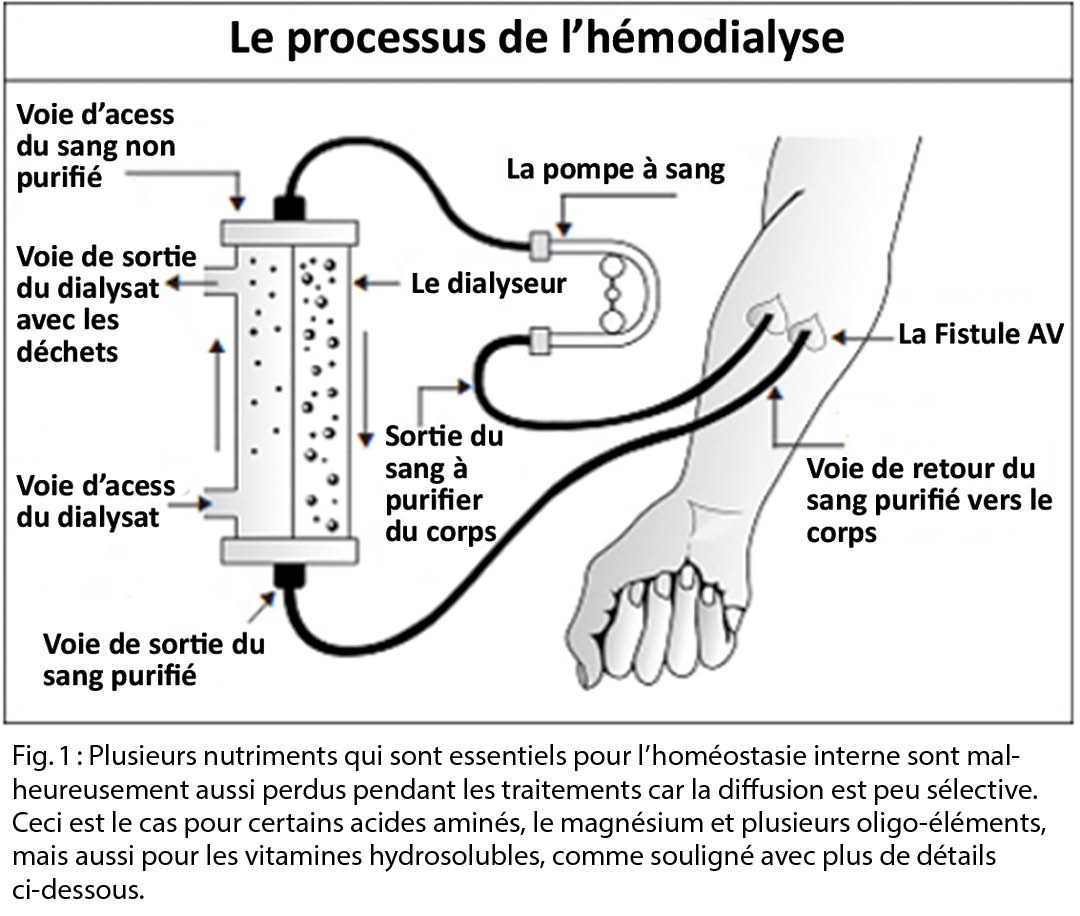
L’ hémodialyse est un traitement hautement technique, qui utilise des filtres semi-perméables, de l’ eau ultra-pure, un mélange d’ électrolytes et un système de circulation extracorporelle permettant d’ épurer le sang (Figure 1). Même s’ il s’ agit d’ un système très puissant, la clairance obtenue des substances clés telles que l’ urée et la créatinine ne dépasse pas 15 ml/min. Le traitement par dialyse ne remplace donc pas de loin toutes les fonctions du rein. En conséquence, les patients doivent continuer à prendre beaucoup de médicaments et combiner cela à des restrictions alimentaires. De plus, la plupart des patients développent une oligurie ou anurie, et doivent également respecter une restriction hydrique.
L’ épuration des substances se fait grâce au principe de diffusion. Pendant une séance d’ hémodialyse, le sang du patient vient au contact d’ un filtre nommé dialyseur (membrane artificielle semi-perméable). Lorsque le sang et la solution de dialyse présentent une concentration différente en molécules, les molécules diffusent à travers la membrane vers la concentration la plus faible. Ceci est par exemple le cas pour le potassium (concentration dans le dialysat: 2-4 mmol/l), l’ urée et le phosphate (concentration dans le dialysat: 0 mmol/l) ; leur concentration baissera fortement pendant chaque séance de dialyse, pour rebondir les heures et jours suivants, jusqu’ à la prochaine séance.
Le vieux démon n’ est pas mort : potassium
Le trouble électrolytique le plus craint chez les patients dialysés et source de multiples restrictions alimentaires, est probablement l’ hyperkaliémie. L’ hyperkaliémie est effectivement en grande partie due à l’ accumulation du potassium provenant de l’ alimentation (fruits, légumes, pommes de terre).
Il est moins connu que la constipation peut également induire ou aggraver l’ hyperkaliémie. L’ élimination du potassium par le colon est trois fois plus élevée chez les patients hémodialysés que chez les volontaires sains. Cela est probablement dû à une conductivité augmentée compensatrice des canaux potassiques des cellules épithéliales du colon(1). Il est donc important d’ éviter et/ou de traiter la constipation, de préférence avec un régime riche en fibres, et/ou avec des laxatifs osmotiques tels que le lactulose ou le polyéthylène glycol (2).
Un certain degré d’ hyperkaliémie est souvent toléré chez les patients dialysés, basé sur des études observationnelles qui ont montré que le risque de mortalité augmente seulement si la kaliémie est >5.6 mmol/l (3). En cas d’ hyperkaliémie conséquente, le néphrologue essaiera dans un premier temps d’ optimiser l’ épuration du potassium par les séances de dialyse, avant d’ insister sur des restrictions alimentaires plus sévères. Le National Kidney Foundation recommande une consommation de <3g (<77 mmol) de potassium par jour pour tous les patients hémodialysés. Afin d’ atteindre ce but, les patients dialysés doivent souvent limiter la consommation
d’ aliments riche en potassium, tels que certains fruits (bananes, abricots,) et légumes (épinards, avocats, haricots, pommes de terre). Les aliments riches en potassium sont également riches en fibres donc leur restriction peut augmenter le risque de constipation, engendrant ainsi un cercle vicieux.
Afin de palier cela, l’ utilisation des chélateurs du potassium est théoriquement une solution intéressante. Les chélateurs disponibles en Suisse sont le polystyrène sulfonate sodique (Résonium®), le polystyrène sulfonate calcique (Sorbisterit®) et plus récemment le patiromer (Veltassa®). Il s’ agit de résines ou polymères (Veltassa®) sous forme de poudre à diluer avec de l’ eau. Au niveau colique, le potassium est échangé contre le sodium ou le calcium présent dans les produits qui sont ensuite éliminés par les selles.
Malheureusement, le Sorbisterit® et le Résonium® peuvent induire dans de rares cas une nécrose et/ou une perforation du côlon (incidence rapportée de 0.27 %), notamment pendant la période post-opératoire (4). Pour cette raison, leur prescription doit être limitée dans le temps. A l’ inverse, cet effet secondaire n’ a pas été décrit pour le Veltassa®. Des études sont en cours afin d’ établir si la prise à long terme de Veltassa® permet de maintenir une alimentation plus riche en fruits, légumes et fibres.
Malnutrition, protéines et acides aminés :
La dénutrition est considérée comme l’une des complications majeures de l’ hémodialyse. Nommée « Protein-energy wasting (PEW) » dans la littérature anglophone, la dénutrition est la conséquence d’ un catabolisme des protéines corporelles supérieur à l’anabolisme. PEW est particulièrement fréquente chez les patients hémodialysés à cause des pertes protéiques dans le dialysat, les restrictions alimentaires limitant l’ hyperphosphatémie et l’ anorexie urémique qui peut persister malgré les séances de dialyse. En revanche, chez les patients avec une insuffisance rénale avancée qui ne sont pas (encore) dialysés, une alimentation trop riche en protéines est associée à un déclin plus rapide du débit de filtration glomérulaire (DFG) et ce, à cause de l’ hyperfiltration et de l’ hyperpression exercée par le régime riche en protéines sur les néphrons résiduels, déjà fortement diminués en nombre.
De manière générale, il est recommandé de consommer 0,6 à 0,8 g/kg/j lorsque le DFG est en dessous de 45 ml/min (5). Les patients en hémodialyse doivent idéalement consommer 1,0 à 1,2 g/kg/j de protéines. La transition vers la dialyse nécessite donc une augmentation importante de la quantité de protéine consommée, sans faire « exploser » le taux de phosphate. A nouveau, l’ implication des diététiciennes est primordiale pour une prise en charge optimale.
Au vu des pertes en acides aminés pendant les séances d’ hémodialyse, le dernier consensus d’ ISRNM ( International Society of Renal Nutrition and Metabolism) a conclu que les repas et les suppléments pendant l’ hémodialyse doivent être offerts à tous les patients sans contre-indications, sur la base d’ études démontrant les bienfaits sur l’ état nutritionnel et le potentiel d’ amélioration d’ autres résultats clés (p. ex., qualité de vie, satisfaction des patients, survie)(6).
Les recommandations KDOQI (Kidney Diases Outcome Quality Initiative) 2020, conseillent également chez les adultes atteints d’ IRT à risque ou présentant une perte protéino-énergétique, un essai d’ au moins 3 mois de suppléments nutritionnels oraux. Ceci améliorerait leur état nutritionnel, le cas échant où les conseils diététiques seuls ne permettraient pas d’atteindre l’ apport énergétique et protéique suffisant aux besoins nutritionnels de base. Pour les patients avec un apport chroniquement insuffisant malgré les suppléments nutritionnels oraux, il est raisonnable d’envisager un essai d’alimentation par sonde entérale (5).
Vitamines :
Les patients hémodialysés ont un risque accru de carences en vitamines. Les causes des carences en vitamines comprennent (a) la prescription de régimes pauvres en potassium et phosphate qui limite la consommation des fruits et légumes frais, des produits laitiers et d’autres produits riches en vitamines ; (b) un métabolisme altéré, comme c’est le cas de la pyridoxine et éventuellement du folate ; (c) une synthèse altérée (par exemple, pour 1,25-dihydroxyvitamine D) ; (d) une possible diminution de l’absorption intestinale (p. ex. la diminution de l’ absorption de riboflavine, de folate et de vitamine D a été constatée chez des rats insuffisants rénaux chroniques) ; et (e) les pertes des vitamines hydrosolubles dans le dialysat, en raison de leur faible poids moléculaire (<1 kDa) (7).
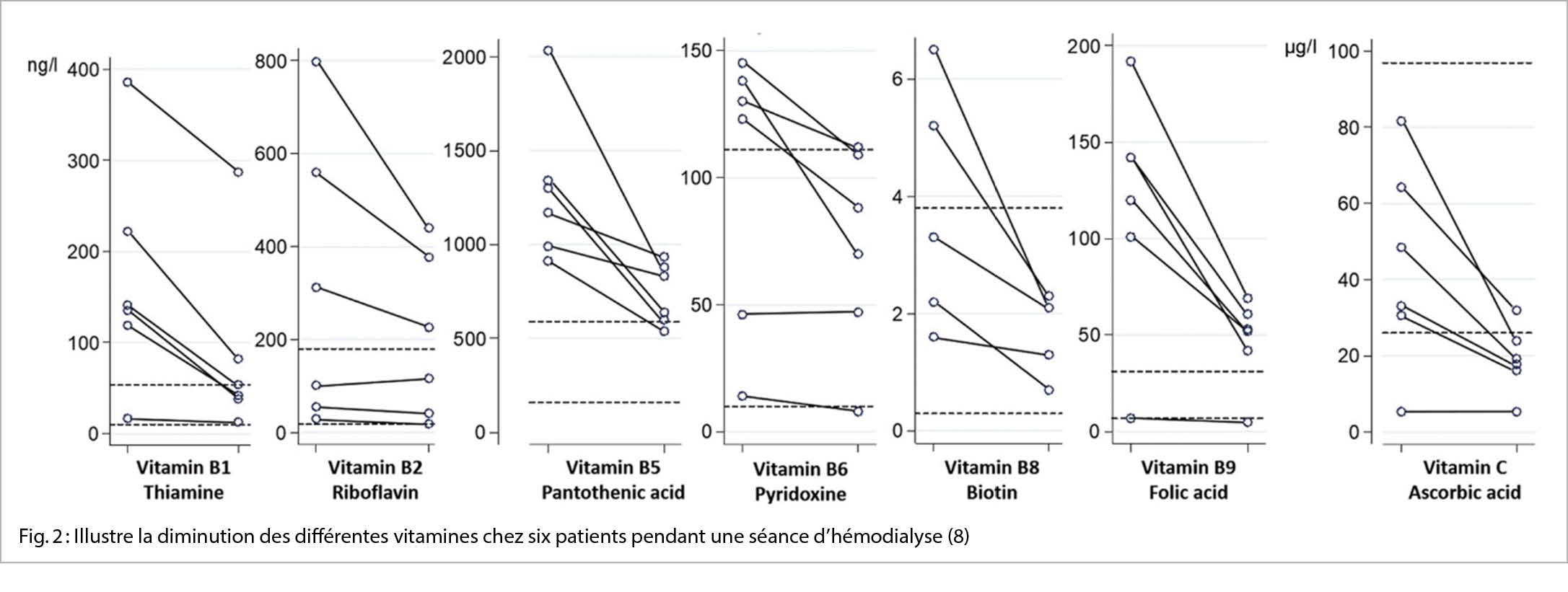
Au cours des dernières décennies, plusieurs avancées technologiques et changements dans la pratique clinique ont été mis en œuvre pour la thérapie HD, y compris l’utilisation de membranes à haut-flux (high-flux) et l’ introduction d’ hémodiafiltration (HDF) (2). Une étude récemment effectuée à Lausanne montre que les pertes vitaminiques sont encore plus importantes en mode HDF qu’ en mode HD, notamment pour la vitamine C (Figure 2) (8) La supplémentation en vitamines hydrosolubles après chaque séance de dialyse est une pratique courante chez les patients hémodialysés chroniques et compense les pertes. Les préparations le plus souvent prescrites sont le Dialvit® (contenant 50mg de vit B1, 10mg de vit B2, 40mg de vit B6, 3 mg d’ acide folique et 200mg de vit C) ou une combinaison de Becozyme forte®, d’ acide folique et de vitamine C. En complément, la plupart des patients reçoivent régulièrement des préparations de vitamine D (cholécalciférol, calcitriol).
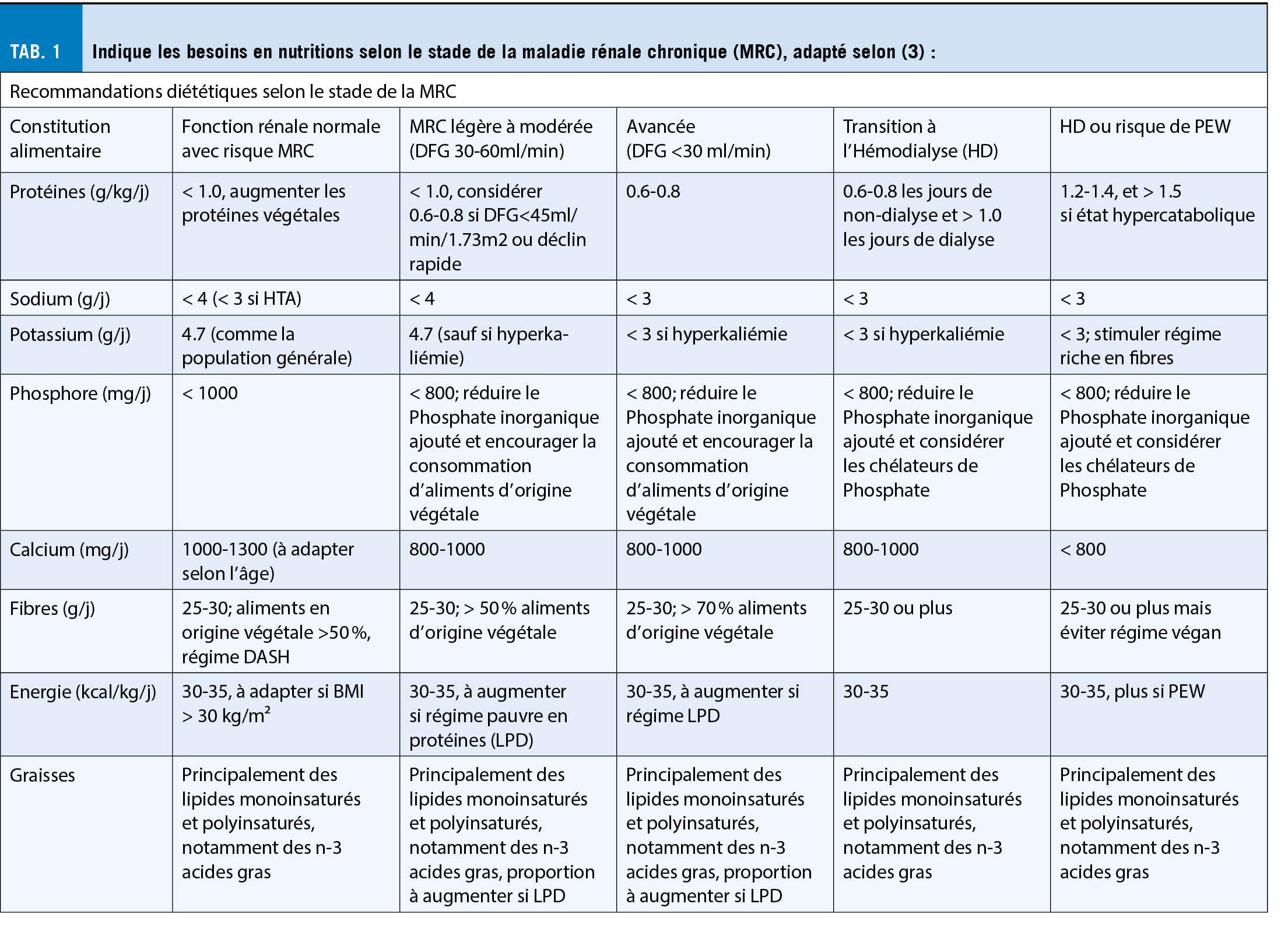
En résumé, les patients hémodialysés présentent de multiples altérations métaboliques, des troubles électrolytiques, ainsi qu’ un risque accru de déficit vitaminique et de dénutrition protéo-énergétique. Une discussion détaillée de tous les aspects est au-delà de la portée de cet article, mais les différentes recommandations alimentaires sont résumées dans le Tableau 1.
Futur : un rôle pour le microbiote ?
Le microbiote intestinal, défini comme l’ ensemble des microorganismes présent dans l’ intestin, a été le sujet de nombreuses recherches au cours de la dernière décennie. Il est devenu clair que le microbiote exerce de nombreuses fonctions bénéfiques au niveau intestinal et systémique, dont la synthèse de la vitamine K, la dégradation de l’ oxalate et la maturation du système immunitaire. Les patients souffrant de maladie rénale chronique ont une composition altérée probablement en réponse à l’ urémie, la prescription fréquente d’ antibiotiques, et les modifications alimentaires. Leur microbiote altéré conduit à une augmentation de la production de molécules telles que le p-crésyl sulfate et l’ indoxyl sulfate, qui ont des effets pro-inflammatoires et pro-calcifiants (9). A son tour, une séance d’hémodialyse est associée à une augmentation passagère de la perméabilité de la barrière intestinale et une augmentation des taux circulants des cytokines. Plusieurs études sont actuellement en cours afin de voir si la prise régulière de probiotiques (microorganismes vivants qui exercent des effets positifs sur la santé) ou prébiotiques (ingrédients alimentaires non digestibles possédant un effet bénéfique sur la composition ou l’ activité du microbiote intestinal) est capable de modifier la composition du microbiote et de retarder ou d’ inverser le trend de la PEW et de perte musculaire.
Conclusions :
L’ insuffisance rénale induit des changements majeurs dans le métabolisme et le milieu interne des patients. Il ne s’ agit pas seulement de troubles électrolytiques, de déficits vitaminiques, de risques accrus en malnutrition mais également de dénutrition protéino-énergétique. L’ hémodialyse peut aggraver le déficit en vitamines et acides aminés, à cause des pertes induites par les filtres hautement perméables. Les conseils et suivis diététiques occupent aujourd’ hui une place majeure dans la prise en charge des patients hémodialysés. D’ autant plus que les connaissances en la matière ne cessent d’ augmenter, permettant ainsi le déploiement de nouvelles stratégies afin d’ atteindre un équilibre homéostatique convenable pour les patients dialysés.
Une collaboration étroite entre néphrologues, diététicien(-ne)s, généralistes, endocrinologues et internistes est essentielle pour une prise en charge optimale de cette catégorie de patients particulièrement vulnérables. L’ avenir nous dira si la manipulation du microbiote s’ imposera comme nouvel outil dans le combat quotidien contre la dénutrition protéino-énergétique.
Copyright Aerzteverlag medinfo AG
Dre Erietta Polychronopoulou
Service de Néphrologie et d’ Hypertension
Centre hospitalier universitaire vaudois et
Université de Lausanne
Rue du Bugnon 17
1011 Lausanne
PD Dr Menno Pruijm
Service de Néphrologie et d’ Hypertension
Centre hospitalier universitaire vaudois et
Université de Lausanne
Rue du Bugnon 17
1011 Lausanne
menno.pruijm@chuv.ch
Nous remercions Mme Wendy Brito pour sa relecture de l’ article.
◆ L’ hyperkaliémie peut être induite ou aggravée par la constipation; en cas d’ hyperkaliémie persistante, une restriction alimentaire de <3g/j s’ impose. Les chélateurs de potassium (à l’ exception du patiromer) ne peuvent pas être prescrits pendant de longues périodes à cause du risque de perforation du côlon.
◆ Les apports protéiniques jouent un rôle important dans le pronostic des patients souffrant de maladies rénales et doivent être adaptés au stade de leur maladie.
◆ Une alimentation optimale pour les patients hémodialysés nécessite une prise en charge spécialisée et multidisciplinaire.
1. Hayes CP, Jr., McLeod ME, Robinson RR. An extravenal mechanism for the maintenance of potassium balance in severe chronic renal failure. Trans Assoc Am Physicians. 1967;80:207-16.
2. Cupisti A, Kalantar-Zadeh K. Management of natural and added dietary
phosphorus burden in kidney disease. Semin Nephrol. 2013;33(2):180-90.
3. Kalantar-Zadeh K, Fouque D. Nutritional Management of Chronic Kidney Disease. N Engl J Med. 2017;377(18):1765-76.
4. Bansal S, Pergola PE. Current Management of Hyperkalemia in Patients on
Dialysis. Kidney Int Rep. 2020;5(6):779-89.
5. Ikizler TA, Burrowes JD, Byham-Gray LD, Campbell KL, Carrero JJ, Chan W,
et al. KDOQI Clinical Practice Guideline for Nutrition in CKD: 2020 Update.
Am J Kidney Dis. 2020;76(3 Suppl 1):S1-S107.
6. Kistler BM, Benner D, Burrowes JD, Campbell KL, Fouque D, Garibotto G, et al. Eating During Hemodialysis Treatment: A Consensus Statement From the International Society of Renal Nutrition and Metabolism. J Ren Nutr. 2018;28(1):4-12.
7. Kendrick J, Chonchol M. The role of phosphorus in the development and
progression of vascular calcification. Am J Kidney Dis. 2011;58(5):826-34.
8. Schwotzer N, Kanemitsu M, Kissling S, Darioli R, Benghezal M, Rezzi S, et al. Water-Soluble Vitamin Levels and Supplementation in Chronic Online Hemodiafiltration Patients. Kidney Int Rep. 2020;5(12):2160-7.
9. Ghajarzadeh-Wurzner A, Berney M, Teta D, Genton L, Pruijm M. [Gut microbiota and kidney diseases : dangerous liaisons?]. Rev Med Suisse. 2018;14(595):422-5.
L’ hyperparathyroïdie est associée à un risque accru de morbidité et mortalité, notamment à cause des manifestations cliniques directes de l’ hypercalcémie et d’ une incidence accrue de maladies cardiovasculaires, osseuses, rénales et de cancers. (1)
La parathyroïdectomie est un traitement curatif qui permet de normaliser les valeurs de PTH, la calcémie, et de résoudre les symptômes. Plusieurs études confirment que la parathyroïdectomie est le traitement de choix en cas d’ hyperparathyroïdie sévère et symptomatique, avec une atteinte d’ organe (2). En revanche, les données sont moins claires concernant l’ indication à la parathyroïdectomie dans la population âgée en présence d’ une calcémie normale ou modérément élevée, et sans symptômes cliniques (3-4).
Méthode
L’ objectif de cette étude randomisée et contrôlée (5) était de comparer l’ efficacité de la parathyroïdectomie (N=95) par rapport au traitement conservateur (N=96) chez 191 patients âgés de 50 à 80 ans présentant une hyperparathyroïdie légère (calcémie corrigée entre 2.60 et 2.80 mmol/L) et recrutés dans 8 centres de référence en Suède, Danemark et Norvège entre octobre 1998 et juin 2005.
Les patients ayant un antécédent de chirurgie au niveau cervical, une forme héréditaire d’ hyperparathyroïdie, une pathologie psychiatrique, des comorbidités somatiques sévères, un antécédent de néphrolithiase dans les 5 ans précédents, ou une créatininémie
supérieure à 130 umol/L ont été exclus.
L’ end-point primaire était la mortalité (registres officiels des décès) et les end-points secondaires comprenaient l’ apparition d’ événements cardio- ou cérébro-vasculaires, d’ une insuffisance rénale, d’ une néphrolithiase, d’ un cancer, ou d’ une fracture ostéoporotique au cours du suivi de 10 ans (visites annuelles de contrôle avec radiographies standards de la colonne). En raison d’ une mortalité plus basse par rapport à ce qui était statistiquement attendu, le suivi a été prolongé à 15 ans dans un deuxième temps.
Résultats
Après 10 ans, 15 patients sont décédés au total, sans différence entre le groupe ayant subi une parathyroïdectomie (N=8 décès) et groupe contrôle (N=7 décès). Au cours du suivi prolongé à 15 ans, 44 décès sont survenus, 24 dans le groupe chirurgical et 20 dans le groupe contrôle, une différence également non significative. Les 101 événements adverses (cardio- ou cérébro-vasculaires, insuffisance rénale, néphrolithiase, cancer, ou fracture ostéoporotique) observés sont survenus avec la même fréquence dans les deux groupes (52 et 49 dans les groupes parathyroïdectomie et contrôle, respectivement)
Commentaire
Les auteurs concluent à l’ absence de bénéfice en termes de mortalité et morbidité de la parathyroïdectomie dans cette population âgée de 50 à 80 ans qui présente une hypercalcémie légère asymptomatique.
Le faible nombre de participants de sexe masculin doit rendre prudent-es dans la généralisation de ces résultats à ce groupe de patients. La mortalité inférieure à ce qui était attendu parmi les participants pourrait aussi indiquer que la population enrôlée était globalement plus robuste qu’ attendu, et les conclusions devraient donc aussi être appliquées avec prudence à la patientèle d’ âge plus élevé, avec un phénotype de fragilité, et/ou une diminution de l’ indépendance fonctionnelle. Finalement, on ne peut exclure que la parathyroïdectomie puisse être indiquée chez certains patients dont l’ espérance de vie est nettement supérieure aux 15 ans de cette étude, et chez lesquels des complications plus tardives pourraient encore survenir.
Néanmoins, cette étude méthodologiquement solide avec une période d’ observation prolongée apporte une réponse robuste à la question épineuse et relativement fréquente de la prise en charge des formes légères d’ hyperparathyroïdie chez les patients âgés de 50 à 80 ans. Dans cette situation, les résultats ne montrent pas de supériorité de la chirurgie par rapport à une surveillance active.
Dr Ilaria Mondo
Service de soins palliatifs et de support CHUV
Av. Pierre-Decker 5
1011 Lausanne
1. Clifton-Bligh PB, Nery ML, Supramaniam R et al. Mortality associated with primary hyperparathyroidism. Bone. 2015;74:121-4.
2. Khan AA, Hanley DA, Rizzoli R et al. Primary hyperparathyroidism: review and
recommendations on evaluation, diagnosis, and management. A Canadian and
international consensus. Osteoporos Int 2017; 28:1–19 DOI 10.1007/s00198-016-3716-2
3. Cusano NE, Cipriani C, Bilezikian JP. Management of normocalcemic primary
hyperparathyroidism. Best Pract Res Clin Endocr Metab 2018;32: 837-845
4. Singh Ospina N, Maraka S, Rodriguez-Gutierrez R, et al. Comparative efficacy of parathyroidectomy and active surveillance in patients with mild primary hyperparathyroidism: a systematic review and meta-analysis; Osteoporos Int 2016; 27:3395–3407
5. Pretorius M, Lundstam K, Heck A, et al. Mortality and morbidity in mild primary hyperparathyroidism: results from a 10-Year prospective randomized controlled trial of parathyroidectomy versus observation. Ann Intern Med 2022; doi:10.7326/M21-4416
En mai 2022, une nouvelle prise de position sur le diagnostic et le traitement de la maladie artérielle périphérique (AOMI) chez les personnes atteintes de diabète sucré a été publiée dans la revue « Die Diabetologie » (1). Cet article de plusieurs sociétés médicales spécialisées allemandes est extrêmement intéressant à lire pour les cardiologues et les internistes.
Nous résumons quelques déclarations importantes pour la pratique : le nombre de patients souffrant d’ AOMI et de diabète sucré ne cesse d’ augmenter. En cas d’ ischémie critique chronique des membres (ICM), la probabilité de diabète est de 50%. En cas de diabète, les lésions vasculaires progressent plus rapidement. Ainsi, le risque d’ AOMI est 2 à 4 fois plus élevé. Après la nicotine, le diabète est le deuxième facteur de risque le plus fréquent. Dans cette population il existe un risque accru d’ amputation. C’ est pourquoi le dépistage précoce de l’ AOMI est si important, de même que le traitement conforme aux directives pour réduire le taux d’ événements cardiovasculaires. Une collaboration interdisciplinaire entre les différentes spécialités médicales et une revascularisation rapide sont essentielles en cas d’ ischémie critique des extrémités. La situation est encore aggravée par le fait que seule une personne sur quatre présente des symptômes ; ceci en raison de la polyneuropathie sensitive qui l’ accompagne. La claudication n’ apparaît que chez 10% des patients atteints d’ AOMI. Souvent, l’ AOMI est masquée par une neuropathie, une dyspnée ou une arthrose supplémentaires. Une ischémie critique – stade III+IV selon Fontaine – peut survenir rapidement, même sans claudication préalable (2, 3).
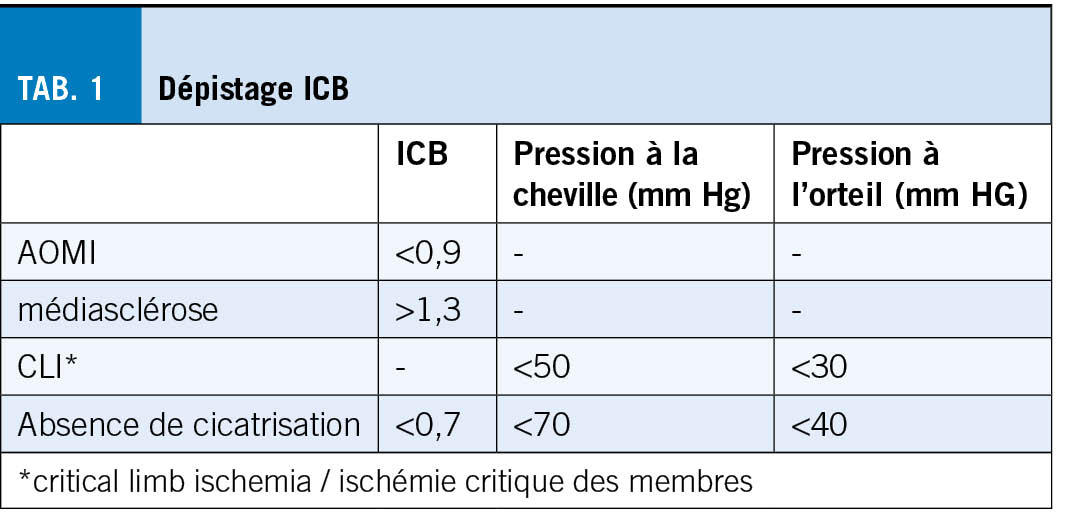
Le diagnostic chez le médecin interniste ou le cardiologue nécessite en premier lieu un examen clinique avec prise du pouls et du pouls capillaire, ainsi qu’ une comparaison qualitative de la couleur et de la température de la peau de chaque côté et une détermination de l’ index cheville-bras ou une mesure de l’ indice de pression systolique à l’ orteil (ICB ; IPSO). La mesure de l’ ICB avec la pression artérielle à la cheville la plus basse est importante pour la détection d’ une AOMI et la stratification du risque. Un ICB au repos <0,9 est considéré comme une preuve d’ une AOMI. Un angiologue doit être consulté en cas d’ un ICB <0,7, de pressions systoliques à orteil <40mmHg ou de pressions systoliques à la cheville <70mmHg. Même un ICB >1,3 (médiasclérose) nécessite un bilan angiologique avec une échographie duplex couleur avec analyse de la courbe du pouls, une oscillographie du pouls des artères digitales et une mesure transcutanée de la pression d’ oxygène. Les procédés d’ imagerie médicale, comme par exemple l’ angiographie par scanner ou par résonance magnétique, ne doivent être effectués que si des conséquences thérapeutiques en résultent.
Outre la gestion générale des facteurs de risque cardiovasculaire (arrêt du tabac, perte de poids, gestion de la glycémie, de la tension et des lipides), le traitement conservateur de la « maladie du lèche-vitrine » consiste en un entraînement structuré à la marche – marcher jusqu’ à/dans la limite de la douleur. En cas d’ AOMI symptomatique, un inhibiteur de l’ agrégation des thrombocytes est indiqué. Dans ce cas, le clopidogrel 75mg est préféré à l’ aspirine 100mg. En cas de risque élevé d’ événement ischémique, une stratégie de coagulation intensifiée est nécessaire : rivaroxaban 2×2,5mg + aspirine 100mg ; également après une intervention vasculaire périphérique ou en cas de CHK ou de sténose carotidienne supplémentaire. Cave : risque accru d’ hémorragie (HR=1,7). En cas d’ hypertension, blocage du SRAA par un inhibiteur de l’ ECA ou un ARA. Cave TA <120mmHg systolique. Pour réduire le risque d’ amputation et la mortalité, il convient de choisir un traitement par statine à la dose maximale tolérée par le patient. En réserve, ajouter de l’ ézétimibe ou du inhibiteur de la PCSK9. Objectif LDL <1,4mmol/l. Comme médicament antidiabétique :
1er choix : metformine et un inhibiteur du SGLT2 ou un agoniste du GLP-1. En réserve, une insuline basale selon les besoins.
L’ article aborde en détail le traitement interventionnel moderne actuel avec PTA, DEB et DES à partir du stade II de Fontaine et d’ une souffrance individuelle élevée et selon le segment de vaisseau concerné. Ce traitement angiologique avec une revascularisation est essentiel pour la prévention des amputations ! L’ ischémie critique des extrémités, le suivi après une intervention vasculaire et la revascularisation chirurgicale sont également abordés. En principe, les options endovasculaires ont la priorité sur les revascularisations chirurgicales. Plus l’ intervention est réalisée en périphérie, plus les résultats à long terme sont mauvais.
Comme le pronostic de l’ AOMI a un rapport avec le risque d’ événements cardiovasculaires majeurs MACE (accident vasculaire cérébral, IDM, décès CV) et de MALE (major adverse limb events) et qu’ elle apparaît souvent masquée, un dépistage ICB en position couchée après 10 min de repos est nécessaire dans les situations suivantes :
Patients atteints de claudication
Plaies non cicatrisantes aux jambes/pieds
Patients asymptomatiques > 65 ans
Patients asymptomatiques < 65 ans ayant des antécédents familiaux
Patients avec d’ autres manifestations d’ athérosclérose (maladie coronarienne, carotide, ……)
Pour le dépistage >55 ans ou même plus tôt avec facteurs de risque cardiovasculaire (cvRF)
Dr. med. Urs N. Dürst
Zelglistrasse 17
8127 Forch
u.n.duerst@ggaweb.ch
1. Die Diabetologie 2022;18: 402–411.
2. Die Diabetologie 2022;18:549-560.
3. CardioUpdate 2022: Hot Topic Angiologie