Malgré l’informatisation du dossier médical, la lettre de sortie reste un élément incontournable du parcours hospitalier d’un-e patient-e.
Son objectif principal reste de transmettre des informations (investigations, réflexions thérapeutiques, interventions et traitements) valides et exhaustives concernant le séjour hospitalier, ainsi que les propositions pour la suite de la prise en charge. Cet exercice exigeant permet (devrait permettre !) aussi de poursuivre un objectif pédagogique de formation à la pensée synthétique, structurée et concise. Plus récemment, un objectif purement financier est venu s’ajouter à ces deux objectifs, allant parfois jusqu’à les supplanter au point de brouiller les priorités. Cette évolution a contribué sans aucun doute au sentiment de surcharge «administrative» du corps médical, même si cette transmission d’informations reste une mission aussi importante que celle de soigner. L’intelligence artificielle (IA) pourra-t-elle nous aider? C’est ce que les résultats d’une étude récente nous font miroiter (1).
Les investigateurs ont extrait au hasard les dossiers de cent patients hospitalisés de 3 à 6 jours en médecine et demandé à un modèle d’IA de type «large language models» (LLM) de générer une lettre de sortie. Celle-ci et la lettre de sortie initiale produite par le médecin en charge ont ensuite été comparées et évaluées à l’aveugle par 22 médecins en termes d’exhaustivité, de clarté et de concision, ainsi que d’éventuelles erreurs (imprécisions, omissions, et hallucinations = informations totalement erronées).
Résultat? Les lettres générées par AI étaient jugées plus claires et plus concises, mais moins exhaustives. Elles contenaient aussi plus souvent une erreur, mais dont les conséquences potentielles ne différaient pas de celles contenues dans la lettre de sortie initiale. Globalement, les reviewers n’ont exprimé aucune différence de préférence pour l’un ou l’autre type de lettre.
Au total, la qualité des deux types de lettres de sortie étaient similaires et, surtout, améliorables. Les auteurs proposent donc d’envisager une approche combinant un premier jet généré par l’IA suivi d’une relecture par le médecin afin d’éliminer les erreurs et améliorer l’exhaustivité. Même si l’on peut craindre que ce soit désormais l’IA qui réponde à l’objectif pédagogique de clarté et concision, cela paraît être une excellente opportunité pour s’attaquer au problème de la surcharge «administrative». À nous de garantir que l’exercice de relecture reste rigoureux!
Pr Christophe Büla
Service de Gériatrie et réadaptation gériatrique,
Centre hospitalier universitaire vaudois
Ch. de Mont Paisible 16
1011 Lausanne
Un Nutri-Score défavorable augmente le risque de maladies cardiovasculaires
Les aliments dont le Nutri-Score est élevé ont un effet négatif sur la santé à long terme. Le Nutri-Score fournit donc aux consommateurs une information simple sur les effets de leur alimentation sur leur santé, grâce à un système de feux tricolores. Il convient toutefois de tenir compte des limites de ces auto-évaluations, car les données présentent également des incohérences, comme un indice de masse corporelle (IMC) plus élevé dans le groupe ayant la meilleure alimentation selon le Nutri-Score par rapport au groupe ayant la pire alimentation. De plus, la qualité de l’alimentation n’a été évaluée qu’au moment de l’inclusion dans l’étude.
Question
L’alimentation selon le Nutri-Score a-t-elle une influence sur le risque de maladies cardiovasculaires?
Lieu de l’étude
Vingt-trois centres de dix pays européens ont participé à l’étude EPIC (European Prospective Investigation into Cancer and Nutrition).
Contexte
Développé par des scientifiques de l’université de Paris, le Nutri-Score utilise les couleurs des feux de signalisation et une échelle de 5 niveaux (de A à E) pour indiquer aux consommateurs si un aliment a des effets néfastes sur la santé en raison de sa teneur élevée en sucre, en acides gras saturés et en sel, ainsi que de sa valeur énergétique élevée. En Suisse, certains fabricants ont récemment annoncé leur intention de ne plus apposer le Nutri-Score sur leurs produits, car il pourrait semer la confusion chez les consommateurs. Des études antérieures avaient déjà montré les effets néfastes de la consommation de nombreux aliments ayant un mauvais Nutri-Score sur les maladies cardiovasculaires.
Critères d’inclusion et d’exclusion
Des adultes âgés de 25 à 70 ans au début de l’étude. Les personnes ayant des antécédents d’infarctus du myocarde ou d’accident vasculaire cérébral, ou ayant subi un tel événement au cours des deux premières années du suivi, ont été exclues.
Méthode
Entre 1992 et 2010, l’étude EPIC a recueilli des données nutritionnelles auprès de plus d’un demi-million de personnes, qu’elle a ensuite mises en relation avec des cancers ultérieurs, mais aussi avec des événements cardiovasculaires.
Entre 1992 et 2010, l’étude EPIC a recueilli des données nutritionnelles auprès de plus d’un demi-million de personnes, puis les a mises en relation avec des cancers et des événements cardiovasculaires survenus par la suite. Dix pays européens ont participé à l’étude et les données de sept d’entre eux ont été évaluées pour la présente étude. Le Nutri-Score, qui repose sur une version mise à jour en 2023 du «nutrient profiling system (NPS)» sous-jacent, a été utilisé pour analyser les données de 345 533 participants à l’étude EPIC.
Paramètres
Maladies cardiovasculaires, maladie coronarienne, infarctus du myocarde, maladie cérébrovasculaire et accident vasculaire cérébral.
Résultats
Au cours des 12.3 années de suivi, 16 214 premiers événements cardiovasculaires ont été enregistrés, dont:
• 11 009 événements coronariens, dont 6565 infarctus du myocarde.
En outre, 6669 événements cérébrovasculaires, dont 6245 accidents vasculaires cérébraux, ont été observés. Un Nutri-Score supérieur d’un écart-type augmentait le risque de maladie cardiovasculaire de 3 % (rapport de risque (HR): 1.03; intervalle de confiance à 95 % (IC): 1.01–1.05).
L’augmentation du risque s’est manifestée comme suit:
• infarctus du myocarde: 3 % (HR 1.03; IC 1.01–1.07);
• événements cérébrovasculaires: 4 % (HR 1.04; IC 1.01–1.07);
• risque d’accident vasculaire cérébral: 4 % (HR 1.04; IC 1.01–1.07). Seul le nombre total d’événements coronariens n’a pas augmenté de manière significative (HR: 1.01; IC: 0.99–1.03), car les angines de poitrine ont été prises en compte en plus des infarctus du myocarde. En comparant les participants ayant obtenu le Nutri-Score le plus bas (le plus favorable) à ceux ayant obtenu le Nutri-Score le plus élevé, on a observé 364 événements pour 100 000 participants contre 490 en 12.3 ans.
Commentaire
• Les aliments ayant un Nutri-Score élevé ont un effet négatif sur la santé à long terme.
• Le Nutri-Score fournit donc aux consommateurs une information simple sur les effets de leur alimentation sur la santé, grâce à un système de feux tricolores.
• Il convient toutefois de tenir compte des limites de ces auto-évaluations, car les données présentent également des incohérences, comme un IMC plus élevé dans le groupe ayant la meilleure alimentation par rapport au groupe ayant la pire selon le Nutri-Score. De plus, la qualité de l’alimentation n’a été évaluée qu’au moment de l’inclusion dans l’étude.
Pr Thomas Rosemann
Source Deschasaux-Tanguy, M. Huybrechts, I. Chantal, J. et al. Nutritional quality of diet characterized by the Nutri-Score profiling system and cardiovascular disease risk: a prospective study in 7 European countries. Lancet Reg Health Europe. 2024; 46:101006 https://www.thelancet.com/journals/lanepe/article/PIIS2666-7762(24)00173-X/fulltext
Anticipation neurale et immunité: le cerveau se prépare aux infections virtuelles
Dans le Journal Nature Neuroscience, Sara Trabanelli (université de Lausanne, université de Genève) et Andrea Serino (université de Lausanne) ont résumé des résultats étonnants. Publiée en juillet 2025, leur étude démontre que le cerveau humain peut anticiper la menace d’une infection, même lorsqu’elle est uniquement représentée en réalité virtuelle, et déclencher une réponse immunitaire mesurable.
Anticipation cérébrale dans l’espace péripersonnel
Le système immunitaire réagit généralement après l’entrée d’un agent pathogène dans l’organisme. Toutefois, l’étude explore une hypothèse différente: le cerveau serait capable de signaler un danger infectieux avant tout contact physique.
Pour ce faire, les chercheurs ont utilisé des avatars en réalité virtuelle présentant des signes visibles de maladie. Lorsque ces avatars pénétraient dans l’espace péripersonnel (la zone immédiate qui entoure le corps), les participants présentaient une activation précoce de régions multisensorielles fronto-pariétales et du réseau de saillance. Spécialisées dans la détection des stimuli menaçants, ces zones du cerveau réagissaient déjà lorsque l’avatar infectieux était encore éloigné.
Les réponses immunitaires étaient comparables à celles observées après une vaccination.
Au-delà des mesures neurophysiologiques, l’équipe a analysé le sang des participants. Après exposition à des avatars infectieux, les cellules lymphoïdes innées (ILC) et les cellules NK présentaient des modifications comparables à celles observées après une vaccination contre la grippe. Les ILC2 et les précurseurs des ILC augmentaient, tandis que les ILC1 diminuaient, signe d’une mobilisation rapide du système immunitaire. Cette modulation était spécifique aux stimuli infectieux et ne se produisait pas avec des stimuli neutres ou effrayants.
Un dialogue neuro-immunitaire
Les chercheurs ont ensuite eu recours à l’IRM fonctionnelle et à la modélisation de la connectivité. Ils ont ainsi démontré que l’anticipation d’une infection virtuelle augmentait les échanges entre le cortex et l’hypothalamus, centre clé de l’axe hypothalamo-hypophyso-surrénalien (HPA).
Ce circuit neuro-immunitaire s’accompagnait d’une libération de médiateurs hormonaux et de lipides inflammatoires. Un réseau neuronal artificiel, entraîné sur ces données, a permis de prédire l’activation immunitaire en fonction des taux d’hormones et de médiateurs lipidiques mesurés dans le sang.
Portée et limites de l’étude
Ces résultats suggèrent que l’organisme ne se contente pas de réagir après une infection, mais qu’il dispose d’une stratégie anticipatoire: le cerveau prépare l’immunité dès qu’il perçoit une menace dans l’environnement.
Cette découverte ouvre la voie à de nouvelles pistes, notamment dans l’utilisation de la réalité virtuelle pour moduler l’immunité. Toutefois, les auteurs soulignent plusieurs limites:
• étude exploratoire chez de jeunes adultes en bonne santé,
• comparaison restreinte à une seule vaccination,
• inconnue quant à la généralisation des résultats à d’autres contextes ou populations.
Conclusion
L’étude révèle une intégration neuro-immunitaire inédite: l’anticipation d’une infection, même simulée en réalité virtuelle, suffit à déclencher une activation des défenses immunitaires.
Ces données confirment que la barrière entre le système comportemental et le système biologique de l’immunité est plus perméable qu’on ne le pensait. Le cerveau joue un rôle central non seulement pour éviter le danger, mais aussi pour préparer activement la réponse immunitaire.
Pr Walter F. Riesen
Source Trabanelli, S., Akselrod, M., Fellrath, J. et al. Neural anticipation of virtual infection triggers an immune response. Nat Neurosci (2025). https://doi.org/10.1038/s41593-025-02008-y
Les infections urinaires (IU) font partie des infections bactériennes les plus fréquentes chez les femmes et constituent un défi croissant en raison de la résistance antimicrobienne (RAM) croissante. Bien que les antibiotiques constituent un traitement efficace, ils sont associés à des risques tels que le développement d’une résistance, des effets secondaires et des perturbations du microbiome. C’est pourquoi les stratégies de prévention non antibiotiques pour les IU non compliquées et récurrentes chez les femmes non enceintes font l’objet d’une attention croissante. L’article met en lumière le contexte épidémiologique, les facteurs de risque à différentes étapes de la vie ainsi que les aspects du diagnostic différentiel, et présente des mesures non antibiotiques fondées sur des preuves, telles que les changements du comportement, l’œstrogénothérapie locale ou les phytothérapies.
Urinary tract infections (UTIs) are among the most common bacterial infections in women and represent a growing challenge due to increasing antimicrobial resistance (AMR). Although antibiotics are an effective therapy, they are associated with risks such as development of resistance, side effects and disruption of the microbiome. Therefore, non-antibiotic prevention strategies for non-complicated, recurrent UTIs in non-pregnant women are increasingly coming into focus. The article highlights the epidemiological background, risk factors in different life stages as well as differential diagnostic aspects and presents evidence-based non-antibiotic measures such as behavioral changes, local estrogen therapy or phytotherapeutics. Keywords: Infections urinaires, prophylaxie non antibiotique, résistances antimicrobiennes, microbiome urogénital
«Il est impossible pour un être humain d’apprendre ce qu’il croit déjà savoir.»
Épictète, philosophe grec (env. 50–138 apr. J.-C.)
Introduction
Les antibiotiques sont efficaces tant dans le traitement des infections urinaires (IU) aiguës que dans la prophylaxie des IU récurrentes. Cependant, compte tenu de l’augmentation de la résistance aux antimicrobiens (RAM) et des complications qui y sont associées, des traitements alternatifs efficaces et une prophylaxie non antibiotique sont nécessaires. Dans cet article, nous nous intéresserons, dans la lignée de la pensée d’Épictète, aux approches préventives alternatives efficaces et non antibiotiques actuellement disponibles en Suisse pour les femmes non enceintes souffrant d’infections urinaires récurrentes non compliquées. Nous apportons ainsi une contribution importante à la prévention de la résistance aux antibiotiques.
Définition
Une infection urinaire est une infection du tractus urogénital présentant les symptômes typiques d’une cystite, tels que dys-urie, envie fréquente d’uriner, pollakiurie, douleur sus-pubienne ou hématurie. Dans le cas d’une infection ascendante telle que la pyélonéphrite, s’ajoutent des douleurs aux flancs, de la fièvre, des nausées ou des vomissements. La pyurie et une culture d’urine positive avec détection d’un uropathogène spécifique sont déterminantes pour le diagnostic. Une IU est considérée comme compliquée en cas d’anomalies anatomiques ou fonctionnelles, de cathétérisme permanent, de grossesse ou de transplantation rénale. Les IU récurrentes sont au moins 2 infections en 6 mois ou au moins 3 en 12 mois. Une nouvelle infection par le même agent pathogène dans les deux semaines suivant la fin du traitement est en revanche considérée comme une rechute. Les symptômes d’une vessie hyperactive idiopathique ou d’un syndrome de douleur vésical ressemblent parfois à ceux d’une infection urinaire, ce dont il faut tenir compte en l’absence d’amélioration malgré la prise d’antibiotiques et une analyse d’urine normale.
Épidémiologie
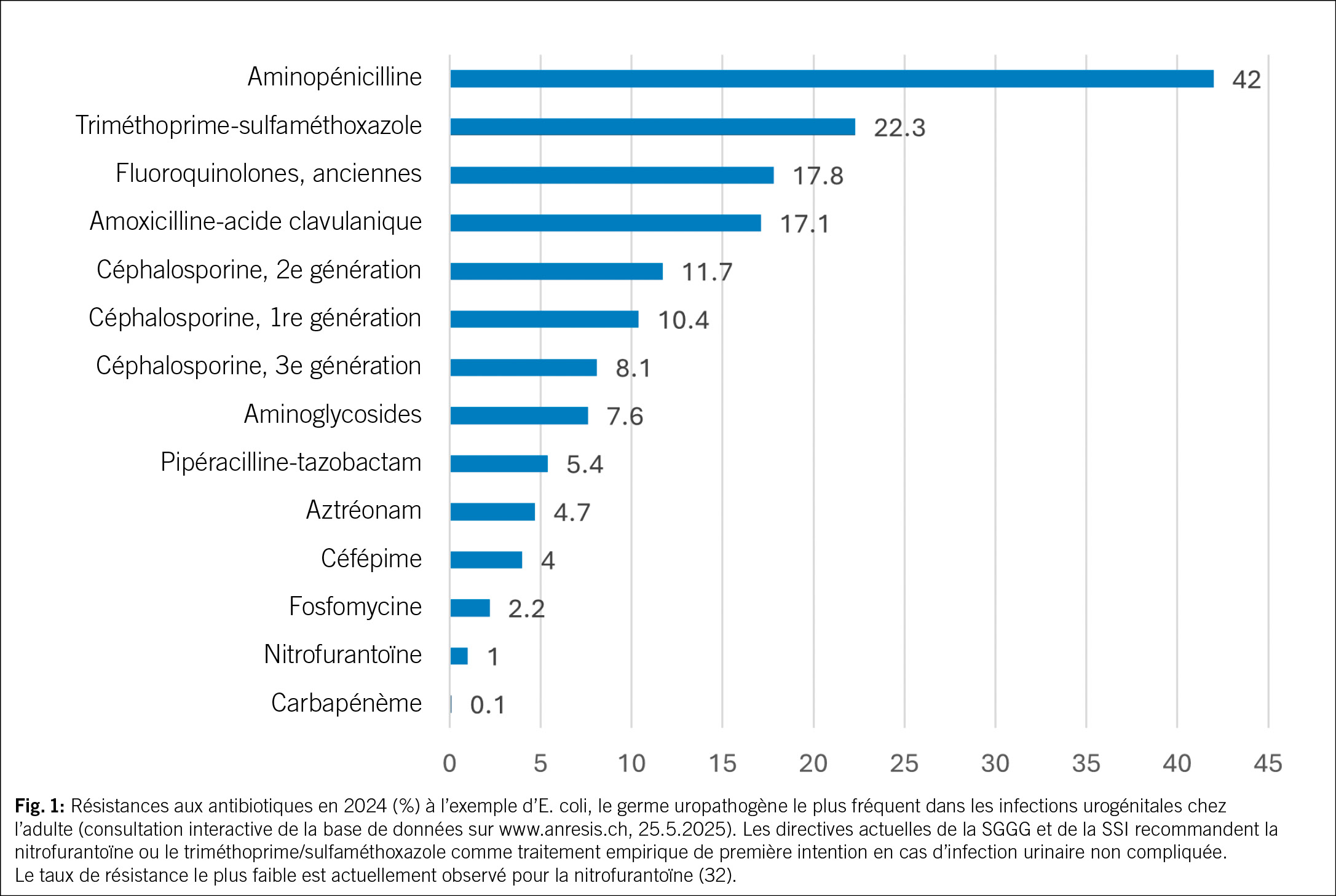
Les infections urinaires comptent parmi les infections bactériennes les plus fréquentes dans le monde et les plus fréquentes chez les femmes: une femme sur deux souffre d’une infection urinaire au cours de sa vie et une sur quatre en souffre plusieurs fois (1). La première recrudescence coïncide avec le début de l’activité sexuelle, les suivantes sont liées à la grossesse et à la ménopause. 20 % de tous les antibiotiques utilisés dans la pratique clinique quotidienne sont prescrits pour traiter des infections urinaires (2, 3). Les IU aiguës et récurrentes peuvent ainsi être traitées efficacement lorsque les traitements non antibiotiques échouent (4–7). À l’échelle mondiale, l’un des plus grands défis médicaux est toutefois l’augmentation de la résistance aux antimicrobiens (RAM) (Fig. 1) avec des agents pathogènes multirésistants et, par conséquent, une augmentation substantielle de la morbidité et de la mortalité (8). Cette question préoccupe également l’Organisation mondiale de la santé (OMS) (https://www.who.int/fr/health-topics/antimicrobial-resistance). La RAM est désormais l’une des causes de décès les plus fréquentes dans le monde, dépassant le VIH/SIDA ou le paludisme. En 2019, une étude a estimé que la RAM avait directement causé 1.27 million de décès et joué un rôle dans 4.95 millions d’autres (9). Il est donc urgent de trouver de nouveaux antibiotiques, mais les nouvelles autorisations sont rares.
Résistance aux antimicrobiens
Ce n’est que depuis peu qu’un nouvel antibiotique, la gépotidacin (autorisé par la FDA le 25 mars 2025), est disponible pour le traitement des infections urinaires non compliquées et de la gonorrhée (10). Son double mécanisme d’action inhibe l’ADN-gyrase bactérienne et la topoisomérase IV, ce qui pourrait réduire le développement de résistances. Reste à voir si cela fonctionnera in vivo. La vie trouve toujours un chemin – et les bactéries aussi. Investir ou non dans de nouveaux antibiotiques est avant tout une décision économique. Mais une utilisation rationnelle permet de réduire la RAM et de protéger nos systèmes de santé (11). C’est pourquoi le Conseil fédéral a lancé le 26 juin 2024 le plan d’action « One Health » dans le cadre de sa « stratégie Antibiorésistance » (StAR) 2024–2027 (12). L’objectif est le renforcement de mesures efficaces et de mettre en œuvre la StAR à l’aide de mesures contraignantes, innovantes et durables, en collaboration avec les offices fédéraux de la santé publique, de la sécurité alimentaire et des affaires vétérinaires, de l’agriculture et de l’environnement, ainsi qu’avec les cantons et d’autres acteurs. Dès lors, des mesures préventives contre les infections urinaires sont utiles pour réduire la consommation d’antibiotiques et le développement de résistances. En outre, l’utilisation d’antibiotiques est également néfaste en raison des effets secondaires suivants: Apparition fréquente de troubles gastro-intestinaux ou de mycoses vaginales, et plus rarement de réactions allergiques ou, comme dans le cas de la nitrofurantoïne, d’une fibrose pulmonaire induite. De plus, l’altération du microbiome de la vessie, du vagin et de l’intestin peut augmenter le risque pour de nouvelles IU et d’autres infections, comme p.ex. par Clostridioides difficile (4–7, 10, 13, 14). La fonction rénale et hépatique des patientes doit également être considérée lors d’un traitement antibiotique, tout comme les interactions possibles avec d’autres médicaments, en particulier chez les patientes âgées sous polypharmacie. Par ailleurs, l’expérience montre que la protection antibiotique prend fin à la fin du traitement.
Peut-on se passer d’antibiotiques?
Mais quand l’utilisation d’antibiotiques est-elle judicieuse? La détection de germes uropathogènes dans la culture d’urine, sans symptômes d’infection urinaire ( = bactériurie asymptomatique), ne nécessite en tout cas pas l’administration d’antibiotiques sauf en cas de grossesse ou d’intervention urologique. Même en cas d’infection urinaire non compliquée, du moins chez certaines patientes sans antécédents de pyélonéphrite et dont les symptômes ne durent que depuis 5 jours au maximum, un traitement non antibiotique avec hydratation accrue et anti-inflammatoires non stéroïdiens peut être tenté pendant 48 heures, (directive SSI).
Facteurs de risque d’infections urinaires récurrentes
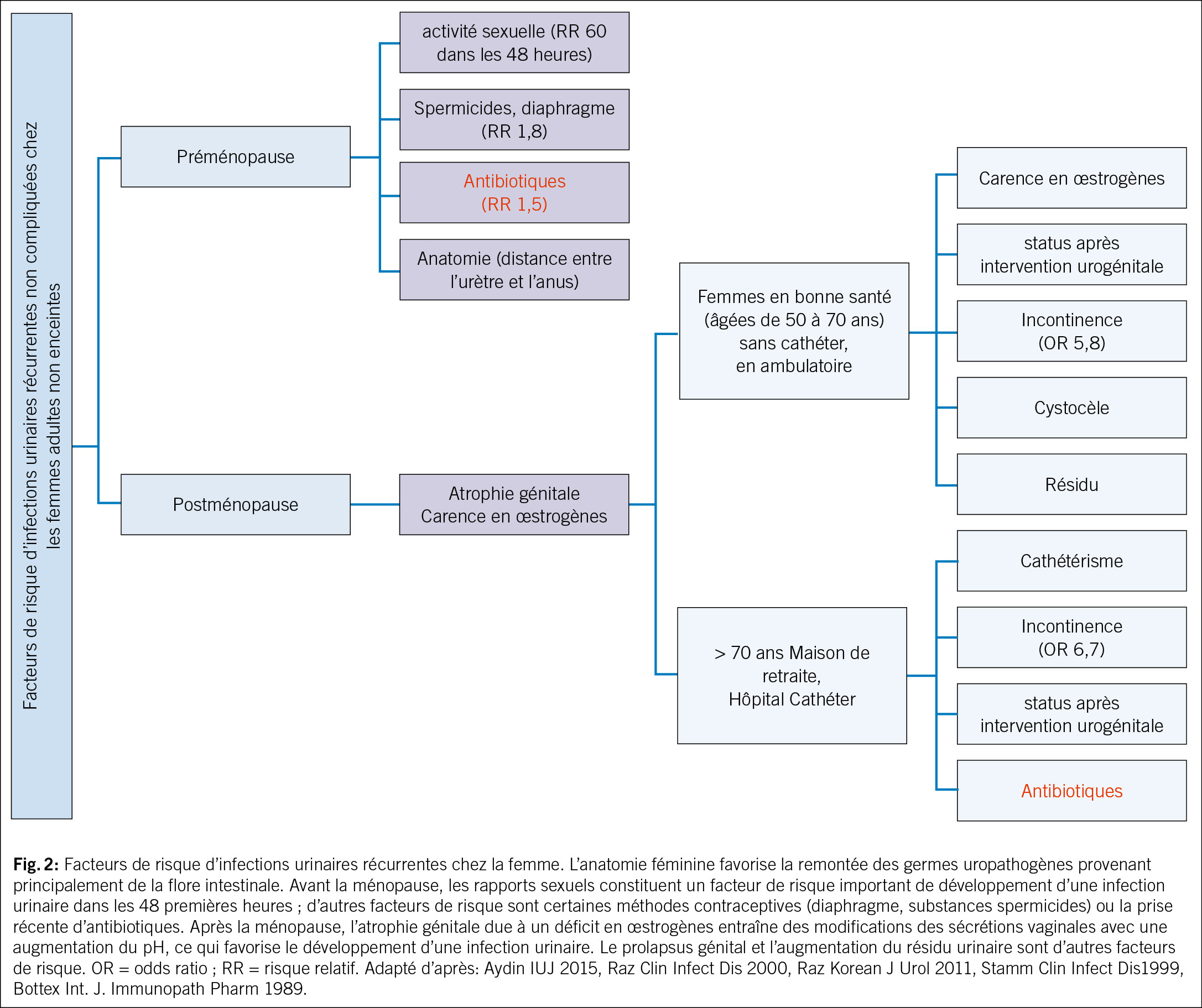
En 2012, un changement de paradigme s’est produit: l’urine n’est pas stérile, même chez les femmes en bonne santé (15, 16). Certaines bactéries E. coli et entérocoques semblent même avoir un effet protecteur (17). Donc, si le traitement antibiotique n’est pas toujours efficace et parfois même contre-productif, des options non antibiotiques deviendraient alors judicieuses. Ainsi, la réduction des facteurs de risque représente une approche importante. Ceux-ci varient pour les femmes avant et après la ménopause (Fig. 2). Parmi les facteurs de risque anatomiques, on compte les muqueuses périurétrales, l’urètre court et les distances entre son ouverture externe et le vagin et l’anus, ce qui favorise l’exposition aux germes uropathogènes provenant principalement de la flore intestinale et leur remontée dans les voies urinaires, et donc les IU (18, 19). Plus ces distances sont courtes, plus les récidives sont fréquentes. Les facteurs de risque préménopausiques sont principalement les rapports sexuels, l’utilisation de spermicides, un nouveau partenaire sexuel, des antécédents d’infections urinaires récurrentes chez la mère, des infections urinaires dans l’enfance et le traitement d’une bactériurie asymptomatique. Les facteurs de risque post-ménopausiques sont la colpite atrophique due à une carence en œstrogènes, une cystocèle et un volume résiduel urinaire augmenté (20). La carence en œstrogènes et la modification de l’urothélium qui en résulte, avec une altération du microbiome urogénital ou « urobiome », augmentent le risque d’IU (21, 22). Les femmes ménopausées souffrant d’infections urinaires récurrentes et prenant quotidiennement des antibiotiques présentent un urobiome modifié avec une augmentation des bactéries anaérobies par rapport aux femmes sans IU (23). Cependant, ce n’est probablement pas un micro-organisme spécifique de l’urobiome qui est associé aux infections urinaires récurrentes, mais plutôt un déséquilibre et un rapport modifié entre certaines espèces de lactobacilles et les bactéries anaérobies. Les antibiotiques ont un effet négatif sur le microbiome et augmentent ainsi le risque d’infections urinaires. Les futures stratégies thérapeutiques pourraient viser à influencer l’urobiome.
Diagnostic
En cas d’infections urinaires récurrentes, un examen gynécolo- gique ou urogynécologique est indiqué. L’examen de base com- prend l’anamnèse (début des infections urinaires, facteurs déclen- chants, comorbidités et facteurs de risque), l’analyse d’urine (bandelettes réactives, sédiment urinaire et culture d’urine avec test de résistance), le status gynécologique (évaluation d’un éventuel prolapsus génital, trophicité des tissus, frottis direct) et la détermination par échographie (US) du résidu urinaire. L’US des voies urinaires sert à exclure des anomalies anatomiques (diverticules urétraux, urolithiase). En cas de facteurs de risque ou d’hématurie indolore, une cystoscopie est indiquée dans l’intervalle. L’examen urodynamique et la mesure du flux urinaire permettent de distinguer une vessie hyperactive, un syndrome douloureux vésical ou une cystite interstitielle.
Options thérapeutiques et prophylactiques
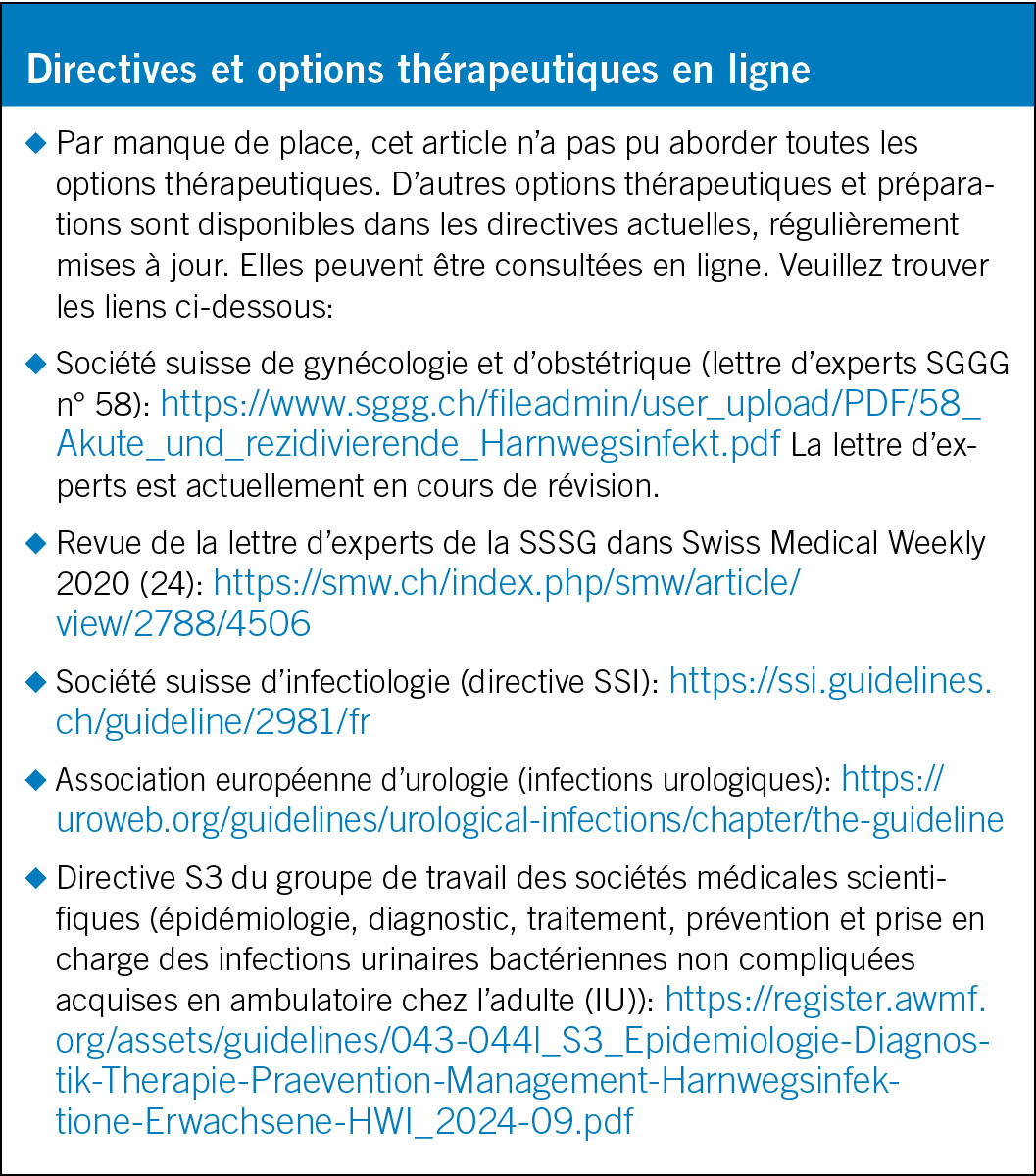
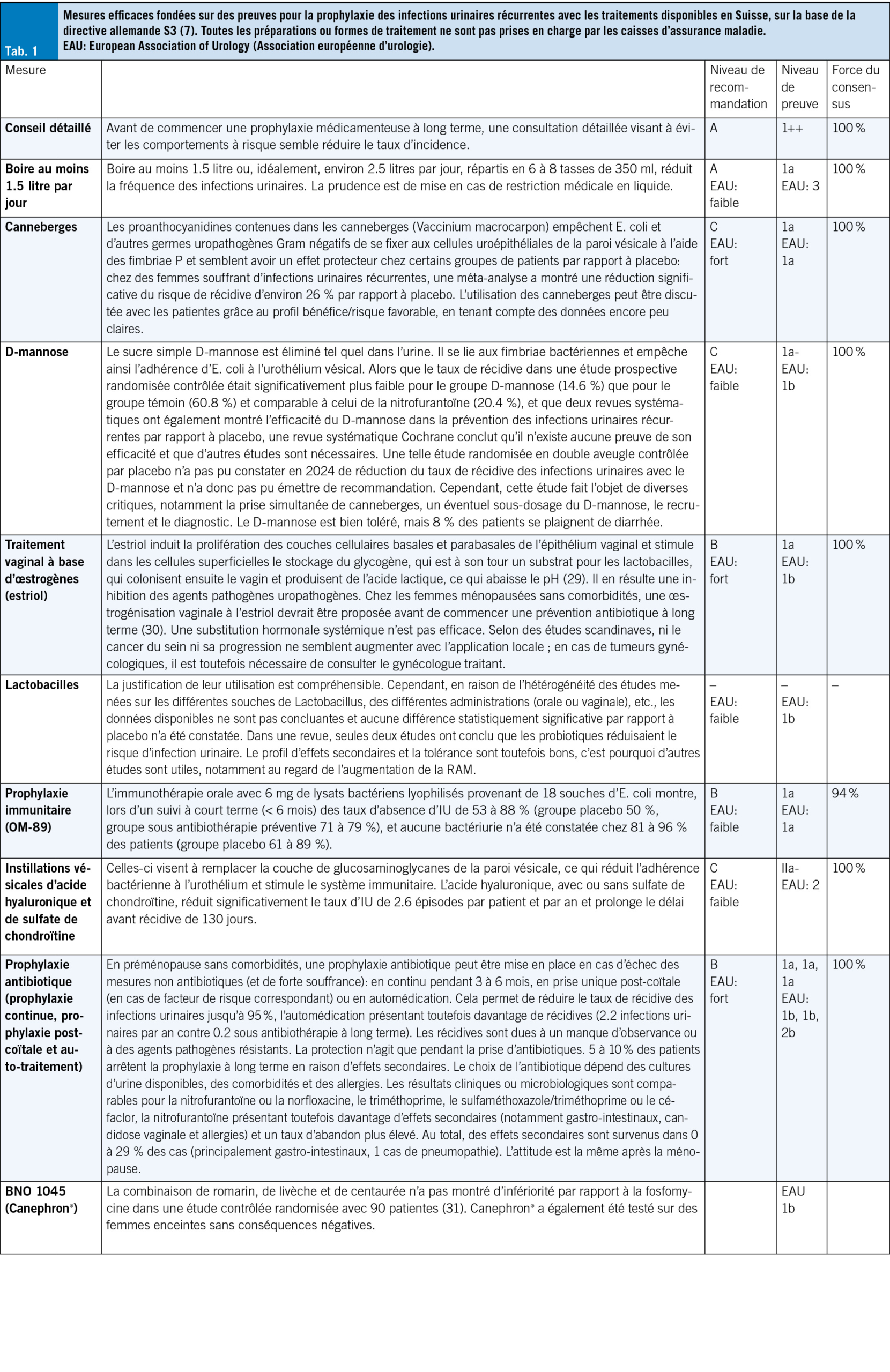
Dans la mesure du possible, les IU aiguës peuvent se traiter de manière symptomatique et sans antibiotiques dans les premiers jours (24). Jusqu’à 50 % des IU non compliquées guérissent ainsi, mais cela prend quelques jours de plus (25, 26). Toutefois, on ne doit pas craindre une infection ascendante: seuls 0.4 à 2.6 % des IU non compliquées non traitées évoluent vers une pyélonéphrite (27), qui se manifeste généralement par de la fièvre ou des douleurs aux flancs. Pour soulager les symptômes de gêne vésicale et favoriser la guérison, il est recommandé de boire suffisamment, ce qui favorise l’élimination des bactéries. En outre, les anti-inflammatoires non stéroïdiens (AINS) tels que l’ibuprofène ou les phytothérapies peuvent également aider (26, 28). En fin de compte, les antibiotiques sont plus efficaces que les AINS dans le traitement des infections urinaires non compliquées, car ils permettent une meilleure éradication bactérienne. En cas d’infections urinaires récurrentes, la prophylaxie et l’identification et la réduction des facteurs de risque sont prioritaires. Une sélection de mesures prophylactiques fondées sur des preuves est résumée dans le Tab 1.
PD Dr David Scheiner, 1, 2, 3 PD Dr Daniele Perucchini 1 Dr Olivia Ziviello 1 Dr Rebecca Zachariah 2, 3 Dr Sören Lange 2, 3 Dr Nicole Keller 2, 3, 4 Prof. Dr Cornelia Betschart 2, 3
1 Centre de la vessie de Zurich, Gottfried Keller-Strasse 7, 8001 Zurich 2 Clinique de gynécologie, Hôpital universitaire de Zurich, Frauenklinikstrasse 10, 8091 Zurich 3 Université de Zurich, Rämistrasse 71, 8006 Zurich 4 Gynécologie et obstétrique, Hôpital de Grabs, Spitalstrasse 44, 9472 Grabs
Copyright
Aerzteverlag medinfo AG
Cet article est une traduction de «info@gynäkologie» 04_25.
PD Dr David Scheiner
– Centre de la vessie de Zurich
Gottfried Keller-Strasse 7
8001 Zurich
– Clinique de gynécologie, Hôpital universitaire de Zurich
Frauenklinikstrasse 10
8091 Zurich
– Université de Zurich
Rämistrasse 71
8006 Zurich
Les auteurs n’ont pas déclaré de conflit d’intérêts en rapport avec cet article.
Le problème croissant de la résistance aux antibiotiques nécessite l’utilisation et le développement d’approches alternatives non antibiotiques pour la prévention des infections urinaires récurrentes.
Les infections récurrentes des voies urinaires sont définies comme au moins deux infections en six mois ou trois en douze mois.
Les facteurs de risque anatomiques et fonctionnels diffèrent chez
les femmes pré- et postménopausées. Ils influencent la prédisposition aux infections urinaires ainsi que les mesures thérapeutiques.
En cas d’infections urinaires aiguës, on peut d’abord essayer un traitement symptomatique sans antibiotiques.
1. Foxman B. Epidemiology of urinary tract infections: incidence, morbidity, and economic costs. Am J Med. 2002;113 Suppl 1A:5S-13S.
2. Wawrysiuk S, Naber K, Rechberger T, Miotla P. Prevention and treatment of uncomplicated lower urinary tract infections in the era of increasing antimicrobial resistance-non-antibiotic approaches: a systemic review. Arch Gynecol Obstet. 2019;300(4):821-8.
3. Bevölkerungsumfrage zu Antibiotikaresistenzen 2020. Schlussbericht im Auftrag des Bundesamts für Gesundheit BAG: Demo SCOPE AG; [updated 30.9.2020. Available from: https://www.newsd.admin.ch/newsd/message/attachments/63835.pdf.
4. Ahmed H, Davies F, Francis N, Farewell D, Butler C, Paranjothy S. Long-term antibiotics for prevention of recurrent urinary tract infection in older adults: systematic review and meta-analysis of randomised trials. BMJ Open. 2017;7(5):e015233.
5. Zeng G, Zhu W, Lam W, Bayramgil A. Treatment of urinary tract infections in the old and fragile. World J Urol. 2020;38(11):2709-20.
6. Price JR, Guran LA, Gregory WT, McDonagh MS. Nitrofurantoin vs other prophylactic agents in reducing recurrent urinary tract infections in adult women: a systematic review and meta-analysis. Am J Obstet Gynecol. 2016;215(5):548-60.
7. S3-Leitlinie Epidemiologie, Diagnostik, Therapie, Prävention und Management unkomplizierter, bakterieller, ambulant erworbener Harnwegsinfektionen bei Erwachsenen (HWI). AWMF Leitlinien-Register. 2024.
8. O’Neill J. Tackling Drug-Resistant Infections Globally: Final Report and Recommendations. London: Wellcome Trust & UK Government Review on Antimicrobial Resistance; 2016.
9. Antimicrobial Resistance C. Global burden of bacterial antimicrobial resistance in 2019:a systematic analysis. Lancet. 2022.
10. FDA. Novel Drug Approvals for 2025 2025 [Available from: xhttps://www.fda.gov/drugs/novel-drug-approvals-fda/novel-drug-approvals-2025.
11. Linhares I, Raposo T, Rodrigues A, Almeida A. Incidence and diversity of antimicrobial multidrug resistance profiles of uropathogenic bacteria. Biomed Res Int. 2015;2015:354084.
12. Strategie Antibiotikaresistenzen Bereich Mensch 2024 [Available from: https://www.bag.admin.ch/bag/de/home/strategie-und-politik/nationale-gesundheitsstrategien/strategie-antibiotikaresistenzen-schweiz.html.
13. Frey N, Bircher A, Bodmer M, Jick SS, Meier CR, Spoendlin J. Antibiotic Drug Use and the Risk of Stevens-Johnson Syndrome and Toxic Epidermal Necrolysis: A Population-Based Case-Control Study. J Invest Dermatol. 2018;138(5):1207-9.
14. Szajewska H, Scott KP, de Meij T, Forslund-Startceva SK, Knight R, Koren O, et al. Antibiotic-perturbed microbiota and the role of probiotics. Nature Reviews Gastroenterology & Hepatology. 2025;22(3):155-72.
15. Wolfe AJ, Brubaker L. “Sterile Urine” and the Presence of Bacteria. European Urology. 2015;68(2):173-4.
16. Fouts DE, Pieper R, Szpakowski S, Pohl H, Knoblach S, Suh MJ, et al. Integrated next-generation sequencing of 16S rDNA and metaproteomics differentiate the healthy urine microbiome from asymptomatic bacteriuria in neuropathic bladder associated with spinal cord injury. J Transl Med. 2012;10:174.
17. Rudick CN, Taylor AK, Yaggie RE, Schaeffer AJ, Klumpp DJ. Asymptomatic bacteriuria Escherichia coli are live biotherapeutics for UTI. PLoS One. 2014;9(11):e109321.
18. Foxman B, Brown P. Epidemiology of urinary tract infections: transmission and risk factors, incidence, and costs. Infect Dis Clin North Am. 2003;17(2):227-41.
19. Hooton TM, Stapleton AE, Roberts PL, Winter C, Scholes D, Bavendam T, et al. Perineal anatomy and urine-voiding characteristics of young women with and without recurrent urinary tract infections. Clin Infect Dis. 1999;29(6):1600-1.
20. Cai T. Recurrent uncomplicated urinary tract infections: definitions and risk factors. GMS Infect Dis. 2021;9:Doc03.
21. Jung C, Brubaker L. The etiology and management of recurrent urinary tract infections in postmenopausal women. Climacteric. 2019;22(3):242-9.
22. Park MG, Cho S, Oh MM. Menopausal Changes in the Microbiome-A Review Focused on the Genitourinary Microbiome. Diagnostics (Basel). 2023;13(6).
23. Vaughan MH, Mao J, Karstens LA, Ma L, Amundsen CL, Schmader KE, et al. The Urinary Microbiome in Postmenopausal Women with Recurrent Urinary Tract Infections. J Urol. 2021;206(5):1222-31.
24. Betschart C, Albrich WC, Brandner S, Faltin D, Kuhn A, Surbek D, et al. Guideline of the Swiss Society of Gynaecology and Obstetrics (SSGO) on acute and recurrent urinary tract infections in women, including pregnancy. Swiss Med Wkly. 2020;150:w20236.
25. Hoffmann T, Peiris R, Mar CD, Cleo G, Glasziou P. Natural history of uncomplicated urinary tract infection without antibiotics: a systematic review. Br J Gen Pract. 2020;70(699):e714-e22.
26. Sachdeva A, Rai BP, Veeratterapillay R, Harding C, Nambiar A. Non-steroidal anti-inflammatory drugs for treating symptomatic uncomplicated urinary tract infections in non-pregnant adult women. Cochrane Database Syst Rev. 2024;12(12):Cd014762.
27. Christiaens TC, De Meyere M, Verschraegen G, Peersman W, Heytens S, De Maeseneer JM. Randomised controlled trial of nitrofurantoin versus placebo in the treatment of uncomplicated urinary tract infection in adult women. Br J Gen Pract. 2002;52(482):729-34.
28. Wagenlehner FM, Abramov-Sommariva D, Höller M, Steindl H, Naber KG. Non-Antibiotic Herbal Therapy (BNO 1045) versus Antibiotic Therapy (Fosfomycin Trometamol) for the Treatment of Acute Lower Uncomplicated Urinary Tract Infections in Women: A Double-Blind, Parallel-Group, Randomized, Multicentre, Non-Inferiority Phase III Trial. Urol Int. 2018;101(3):327-36.
29. Raz R, Stamm WE. A controlled trial of intravaginal estriol in postmenopausal women with recurrent urinary tract infections. N Engl J Med. 1993;329(11):753-6.
30. Tan-Kim J, Shah NM, Do D, Menefee SA. Efficacy of vaginal estrogen for recurrent urinary tract infection prevention in hypoestrogenic women. Am J Obstet Gynecol. 2023;229(2):143 e1- e9.
31. Sabadash M, Shulyak A. Canephron® N in the treatment of recurrent cystitis in women of child-bearing Age: a randomised controlled study. Clinical Phytoscience. 2017;3(1):9.
32. Huttner A, Kronenberg A, Hasse B, Galperine TK. Harnwegsinfekt (HWI). 2025.
Les inhibiteurs de points de contrôle immunitaires ont transformé la prise en charge de nombreux cancers. Cette immunothérapie permet potentiellement un contrôle prolongé, voire la guérison, chez certains patients atteints de cancer avancé. Toutefois, malgré ces avancées notables, seuls environ 20 % des patients avec maladie avancée en bénéficient, et moins encore sur le long terme. Les effets indésirables, parfois tardifs, et potentiellement sévères, exigent vigilance, et une prise en charge rapide en centre expert. Transformer des tumeurs résistantes plus sensible à l’immunothérapie est un des défis majeurs. Optimiser l’administration – en termes de dose, durée, etc. – en est un autre.
Immune checkpoint inhibitors have transformed the management of many cancers. Immunotherapy can lead to prolonged disease control, and even cure, in some patients with advanced cancer. However, despite these notable advances, only about 20 % benefit from immunotherapy in the advanced setting, and even fewer in the long term. Adverse events, sometimes occurring late and potentially severe, require close monitoring and rapid management in expert centers. Among future challenges is the need to make resistant tumors more sensitive to immunotherapy. Optimizing its use – in terms of dose, duration, etc. – is another important goal. Keywords: Immune checkpoint inhibitors; anti-tumoral immunity; oncology; PD1; CTLA-4
Introduction
Bien que le terme immunothérapie englobe diverses approches, ce terme fait le plus souvent référence aux inhibiteurs de points de contrôle immunitaires (checkpoint inhibitors), que nous allons décrire ici. Ces inhibiteurs de points de contrôle immunitaires constituent certainement l’avancée la plus importante en oncologie de ces deux dernières décennies. Pour certains patients – par exemple ceux atteints de cancer du poumon ou de mélanome – elle a permis de transformer des maladies métastatiques autrefois incurables en affections contrôlées à long terme, permettant même parfois de parler de guérison, y compris dans des stades initialement extrêmement avancés. Toutefois, ces situations favorables, bien qu’elles fassent désormais partie de la pratique quotidienne, restent limitées à un nombre restreint de types tumoraux. En situation de maladie avancée, seule une minorité de patients bénéficie réellement de l’immunothérapie. Par ailleurs, les effets secondaires, pouvant concerner pratiquement n’importe quel organe par des mécanismes immuno-médiés, ne doivent pas être minimisées. Savoir les reconnaître et les prendre en charge est d’une importance capitale pour le praticien. Dans ce travail, nous revenons sur le rationnel biologique, les données cliniques d’efficacité et de tolérance de l’immunothérapie, ainsi que les directions envisagées pour le futur de l’immunothérapie.
Rationnel biologique
Toute personne possède une immunité naturelle anti-tumorale, dont l’objectif est d’éliminer les cellules anormales. Cette immunité est finement régulée afin qu’elle ne soit ni excessive, ni insuffisante, notamment grâce à ce que l’on appelle des points de contrôle immunitaires (immune checkpoints). Il s’avère que ces points de contrôle peuvent être détournés par les cellules cancéreuses pour échapper à la surveillance immunitaire (1).
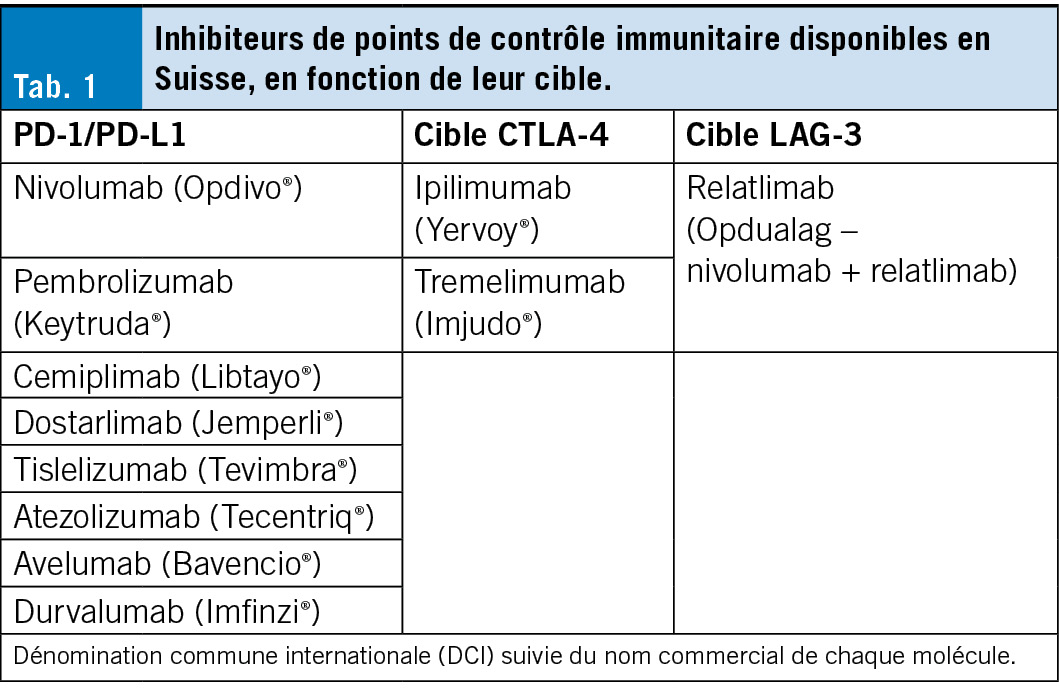
Parmi ces points de contrôle, ceux qui ont révolutionné l’oncologie sont principalement l’interaction entre PD-1 et PD-L1, ainsi que celle entre CTLA-4 et les cellules présentatrices d’antigènes (2). D’autres points de contrôle, comme LAG-3, TIGIT ou TIM-3, font l’objet de développements récents, mais ne seront pas abordés dans ce manuscrit (3). La Tab. 1 décrit le nom des molécules, et leur cible, disponibles en Suisse.
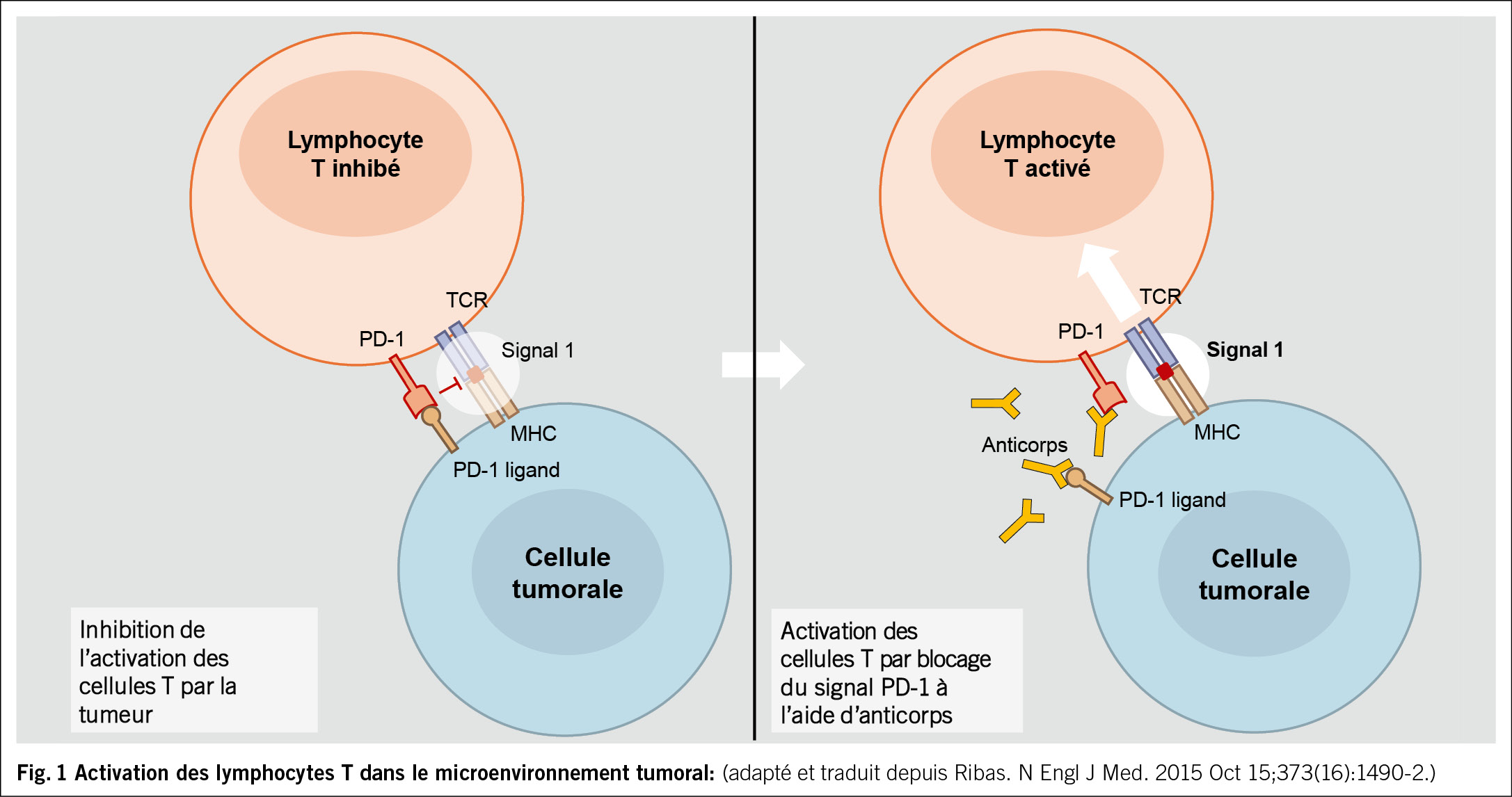
Prenons l’exemple de l’interaction entre PD-1, exprimé à la surface des lymphocytes T, et PD-L1, exprimé par les cellules tumorales: cette interaction inhibe le lymphocyte, l’empêchant d’exercer son effet cytotoxique anti-tumoral. Le cancer, notamment via une surexpression de PD-L1, parvient ainsi à échapper à la réponse immunitaire et à poursuivre sa progression. Ce mécanisme est illustré dans la Fig. 1.
C’est précisément à ce niveau que l’immunothérapie intervient: des anticorps monoclonaux (monoclonal antibodies – «mab») bloquent cette interaction, restaurant la capacité des lymphocytes T à reconnaître et à détruire les cellules cancéreuses. L’immunothérapie n’agit donc pas directement contre la tumeur, mais indirectement, en levant les freins exercés sur la réponse immunitaire (immune checkpoint inhibitors).
Données en situations métastatiques
Une revue exhaustive des données d’immunothérapie des vingt dernières années dépasserait le cadre de ce travail. Toutefois, des exemples marquants illustrent le potentiel de cette nouvelle approche thérapeutique.
Le mélanome était autrefois associé à un pronostic très réservé, avec une espérance de vie de quelques mois dans beaucoup des situations métastatiques. C’est dans ce contexte que l’immunothérapie a été la plus révolutionnaire. Nous disposons désormais des résultats à 10 ans de l’étude CheckMate 067, qui a comparé une combinaison d’immunothérapie (anti-CTLA-4 et anti-PD-1), les anti-PD-1 seuls, et les anti-CTLA-4 seuls, en 1ère ligne de traitement pour des patients avec maladie avancée ou métastatique (4). Avec les stratégies contenant un anti-PD-1 (seul ou en combinaison), environ 40 % des patients sont encore en vie à 10 ans. Chez ces patients, on peut véritablement parler de guérison.
D’autres cancers ont vu leur prise en charge radicalement transformée par l’immunothérapie. Par exemple, le cancer du poumon, qui, en dehors de cas particuliers, est aujourd’hui traité par immunothérapie dès la première ligne en situation métastatique, avec là aussi un potentiel de bénéfice à très long terme en cas de réponse tumorale (5, 6, 7).
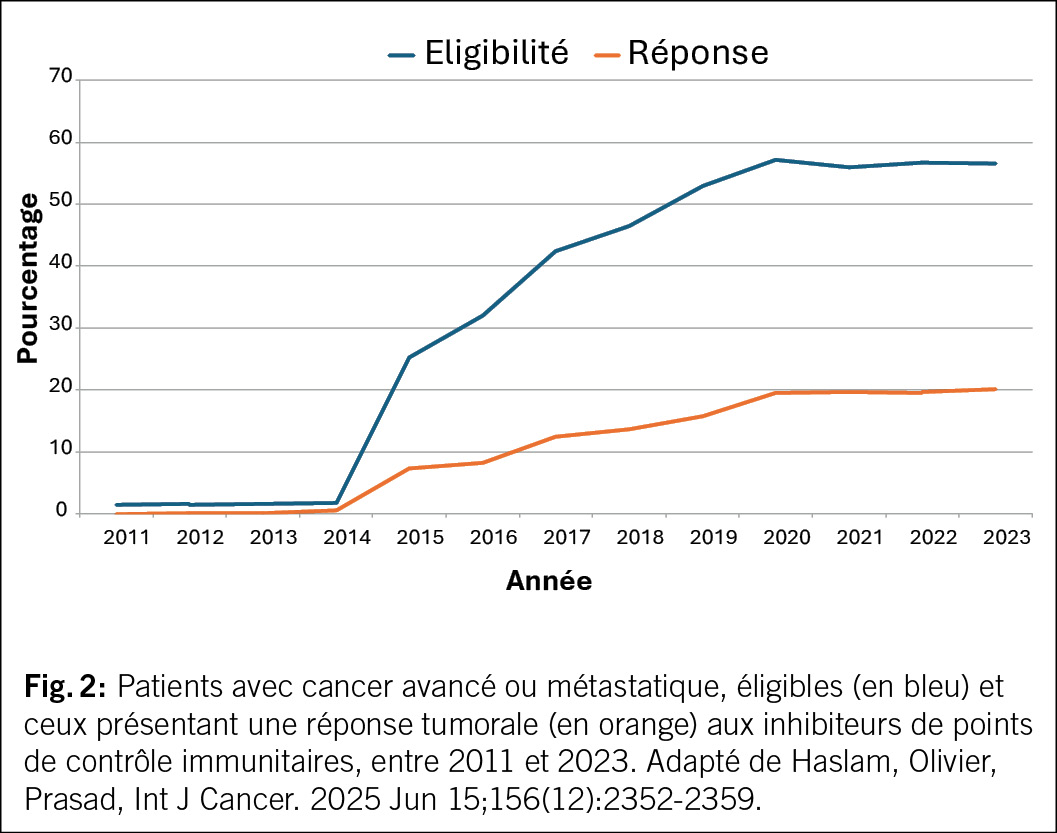
L’exemple du mélanome illustre également les limites de l’immunothérapie: il s’agit d’un cancer relativement rare, en situation avancée, comparé à d’autres. Cela explique qu’à ce jour, si l’on tient compte de la fréquence de chaque type de cancer, seulement environ 20 % des patients atteints de maladie avancée bénéficient d’une réponse tumorale à l’immunothérapie (8). De plus, seule une fraction de ces patients va avoir un bénéfice durable dans le temps. L’évolution au cours du temps du nombre de patients avec maladie avancée ou métastatique étant éligible, c’est à dire avec une indication à recevoir la thérapie, et ceux présentant une réponse tumorale, est représenté dans la Fig. 2. En d’autres termes, bien que l’immunothérapie représente une révolution pour certains patients, elle ne bénéficie encore qu’à une minorité des personnes atteintes de maladie avancée.
Et en situation néoadjuvante et adjuvante?
Après les résultats impressionnants observés dans certaines situations de maladie avancée, il a été logique d’étudier l’impact de l’immunothérapie dans des contextes plus précoces, notamment en situation néoadjuvante (avant chirurgie) et/ou adjuvante (après chirurgie) (9, 10).
Dans le cancer du poumon par exemple, un nombre considérable d’études de phase 3 a montré un bénéfice en survie sans maladie, et plusieurs d’entre elles ont également mis en évidence un bénéfice en survie globale, lié à l’adjonction d’immunothérapie aux traitements conventionnels de chimiothérapie péri-opératoire (11, 12 13). Aujourd’hui, l’immunothérapie peut être proposée en situation péri-opératoire dans de nombreux types tumoraux.
Il convient toutefois d’apporter certaines nuances : en effet, plusieurs études soutenant l’utilisation précoce de l’immunothérapie ont été menées y compris dans certains pays à ressources limitées. Dans ces pays, les patients du groupe contrôle qui récidivaient n’avaient pas un accès optimal aux traitements après l’essai clinique (10). Dans ces cas, il est difficile de savoir si le bénéfice observé en survie est réellement dû à l’administration précoce de l’immunothérapie, ou s’il résulte d’un traitement sous-optimal dans le groupe contrôle lors de la rechute. Un autre point important concerne la toxicité, qui, dans une situation où les patients sont potentiellement déjà guéris de leur maladie, doit être évaluée avec encore plus d’attention dans le cadre d’une véritable décision médicale partagée.
Toxicité et qualité de vie: savoir repérer et ne pas minimiser
Les toxicités potentielles de l’immunothérapie ne doivent pas être sous-estimées. Bien que sévères dans une minorité de cas, et souvent contrôlables médicalement, certaines toxicités peuvent entraîner des dommages à long terme (14), avec un impact potentiel sur la qualité de vie (15), voire des effets secondaires fatals (16).
Pour le praticien, les messages clés sont les suivants:
1. Les toxicités immuno-induites sont des atteintes d’organes qui peuvent mimer d’autres pathologies, rendant leur diagnostic parfois piégeux. Par exemple, une pneumonite immuno-médiée peut se présenter comme une pneumonie infectieuse. Les atteintes les plus fréquentes concernent les glandes endocrines (thyroïdites) poumons (pneumonites), le côlon (colites), le foie (hépatites), la peau, ainsi qu’une asthénie marquée. Des atteintes plus rares mais sévères, telles que des myosites cardiaques ou des atteintes neurologiques, peuvent également survenir (17).
2. Contrairement à la chimiothérapie, les effets indésirables de l’immunothérapie peuvent apparaître tardivement, plusieurs semaines voire plusieurs mois après le début, ou même l’arrêt, du traitement (18).
3. La corticothérapie à forte dose, initiée rapidement, constitue la base du traitement de première intention, en visant à freiner une réponse immunitaire devenue excessive. En cas de résistance, d’autres immunosuppresseurs peuvent être nécessaires, comme les anti-IL6, anti-TNF alpha, ou d’autres molécules (19) (20).
4. La gestion optimale de ces toxicités repose sur une expertise spécialisée. L’implication précoce de l’oncologue référent est essentielle pour éviter des retards de diagnostic ou de traitement.
En conclusion, bien que généralement bien tolérée, l’immunothérapie peut provoquer des effets indésirables sévères. Leur reconnaissance rapide, leur prise en charge en centre expert, et une information claire au patient comme à son entourage sont des éléments clés pour assurer la sécurité et l’efficacité du traitement.
Défis pour le futur
Sur le plan de l’efficacité, une question centrale demeure: est-il possible que l’immunothérapie ne bénéficie plus seulement à une minorité, mais à une majorité de patients? Différentes stratégies sont actuellement explorées pour atteindre cet objectif, notamment en ciblant d’autres points de contrôle immunitaires, ou en cherchant à transformer des cancers dits «froids» (résistants à l’immunothérapie) en cancers «chauds», c’est-à-dire plus sensibles.
Parallèlement, un autre défi majeur réside dans l’optimisation des traitements déjà approuvés, avec une approche centrée sur le patient (21). Par exemple:
– Les doses actuellement utilisées sont-elles réellement optimales? Certaines études suggèrent qu’une efficacité comparable pourrait être obtenue avec des doses significativement plus faibles (22).
– Le moment d’administration joue-t-il un rôle? Plusieurs données préliminaires indiquent que l’administration le matin pourrait être plus efficace que l’après-midi, mais cette hypothèse mérite d’être validée par des essais randomisés rigoureux (23).
– La durée du traitement est-elle justifiée? Beaucoup de protocoles prévoient une immunothérapie sur un ou deux ans. Or, évaluer si des durées plus courtes peuvent offrir une efficacité équivalente permettrait de limiter les toxicités, mais aussi de réduire considérablement les coûts pour la société (24).
Conclusion
Les inhibiteurs de points de contrôle immunitaires ont représenté une véritable révolution en oncologie, permettant à certains patients d’obtenir un contrôle durable de la maladie, voire une guérison, alors que leur pronostic aurait été rapidement létal en l’absence de ce traitement. Malgré tout, cela ne concerne encore qu’une minorité de patients atteints de maladie avancée. Comprendre comment élargir le bénéfice de l’immunothérapie à un plus grand nombre de patients reste un défi majeur. Les toxicités, des atteintes d’organes immuno-médiées pouvant survenir plusieurs semaines, voire plusieurs mois après le début du traitement, doivent être repérées précocement et traitées sans délai (la corticothérapie étant le traitement de première intention), avec une implication rapide de l’oncologue. En situation néoadjuvante ou adjuvante, ces toxicités, ainsi que certains biais méthodologiques parfois présents dans les essais cliniques, doivent être pleinement pris en compte dans le cadre d’une décision médicale partagée optimale.
Copyright
Aerzteverlag medinfo AG
PD Dr Timothée Olivier
Service d’oncologie
Hôpitaux Universitaires Genève
Rue Gabrielle-Perret-Gentil 4
1205 Genève
Pr Alfredo Addeo
Service d’oncologie
Hôpitaux Universitaires Genève
Rue Gabrielle-Perret-Gentil 4
1205 Genève
Timothée Olivier n’a pas de conflits d’intérêt à déclarer. Alfredo Addeo: Consulting or Advisory Role: BMS, Astrazeneca, Boehringer-Ingelheim, Roche, MSD, Pfizer, Eli Lilly, Astellas. Speaker Bureau: Eli Lilly, Astrazeneca, Regeneron
L’immunothérapie permet, dans certains types de cancers y compris en situations très avancés ou métastatiques, un contrôle durable, voire une guérison – mais cela reste limité à une minorité de patients.
Les effets indésirables immuno-médiés peuvent survenir tardivement et toucher divers organes ; ils doivent être identifiés et pris en charge rapidement, en centre expert, avec une corticothérapie en première intention.
En situation néoadjuvante ou adjuvante, l’immunothérapie est de plus en plus proposée, mais impose une évaluation rigoureuse du rapport bénéfice-risque dans une véritable décision médicale partagée.
Pour élargir le bénéfice à plus de patients, des pistes sont explorées pour transformer des tumeurs résistantes en maladies plus sensibles à l’immunothérapie.
Optimiser la dose, la durée d’administration, et d’autres éléments
en lien avec l’administration d’immunothérapie déjà utilisée, pourrait potentiellement en réduire la toxicité et les coûts.
1. Chen DS, Mellman I. Oncology meets immunology: the cancer-immunity cycle. Immunity. 2013 Jul 25;39(1):1–10.
2. Ribas Antoni. Releasing the Brakes on Cancer Immunotherapy. New England Journal of Medicine. 2015;373(16):1490–2.
3. Borgeaud M, Sandoval J, Obeid M, Banna G, Michielin O, Addeo A, et al. Novel targets for immune-checkpoint inhibition in cancer. Cancer Treatment Reviews [Internet]. 2023 Nov 1 [cited 2025 Jun 22];120. Available from: https://www.cancertreatmentreviews.com/article/S0305-7372(23)00107-X/fulltext
4. Wolchok JD, Chiarion-Sileni V, Rutkowski P, Cowey CL, Schadendorf D, Wagstaff J, et al. Final, 10-Year Outcomes with Nivolumab plus Ipilimumab in Advanced Melanoma. New England Journal of Medicine. 2025 Jan 1;392(1):11–22.
5. Garassino MC, Gadgeel S, Speranza G, Felip E, Esteban E, Dómine M, et al. Pembrolizumab Plus Pemetrexed and Platinum in Nonsquamous Non–Small-Cell Lung Cancer: 5-Year Outcomes From the Phase 3 KEYNOTE-189 Study. JCO. 2023 Apr 10;41(11):1992–8.
6. Novello S, Kowalski DM, Luft A, Gümüs M, Vicente D, Mazières J, et al. Pembrolizumab Plus Chemotherapy in Squamous Non–Small-Cell Lung Cancer: 5-Year Update of the Phase III KEYNOTE-407 Study. JCO. 2023 Apr 10;41(11):1999–2006.
7. Desai A, Peters S. Immunotherapy-based combinations in metastatic NSCLC. Cancer Treat Rev. 2023 May;116:102545.
8. Haslam A, Olivier T, Prasad V. How many people in the US are eligible for and respond to checkpoint inhibitors: An empirical analysis. Int J Cancer. 2025 Jun 15;156(12):2352–9.
9. Boydell E, Sandoval JL, Michielin O, Obeid M, Addeo A, Friedlaender A. Neoadjuvant Immunotherapy: A Promising New Standard of Care. Int J Mol Sci. 2023 Jul 24;24(14):11849.
10. Olivier T, Haslam A, Prasad V. Postrecurrence Treatment in Neoadjuvant or Adjuvant FDA Registration Trials: A Systematic Review. JAMA Oncology [Internet]. 2024 Jun 20 [cited 2024 Aug 15]; Available from: https://doi.org/10.1001/jamaoncol.2024.1569
11. Han Y, Xiao X, Qin T, Yao S, Liu X, Feng Y, et al. Efficacy and safety of perioperative immunotherapy combinations for resectable non-small cell lung cancer: a systematic review and network meta-analysis. Cancer Immunol Immunother. 2024 Oct 9;73(12):262.
12. Spicer JD, Garassino MC, Wakelee H, Liberman M, Kato T, Tsuboi M, et al. Neoadjuvant pembrolizumab plus chemotherapy followed by adjuvant pembrolizumab compared with neoadjuvant chemotherapy alone in patients with early-stage non-small-cell lung cancer (KEYNOTE-671): a randomised, double-blind, placebo-controlled, phase 3 trial. The Lancet. 2024 Sep 28;404(10459):1240–52.
13. Forde PM, Spicer JD, Provencio M, Mitsudomi T, Awad MM, Wang C, et al. Overall Survival with Neoadjuvant Nivolumab plus Chemotherapy in Lung Cancer. New England Journal of Medicine [Internet]. [cited 2025 Jun 22];0(0). Available from: https://www.nejm.org/doi/full/10.1056/NEJMoa2502931
14. Ghisoni E, Wicky A, Bouchaab H, Imbimbo M, Delyon J, Gautron Moura B, et al. Late-onset and long-lasting immune-related adverse events from immune checkpoint-inhibitors: An overlooked aspect in immunotherapy. European Journal of Cancer. 2021 May 1;149:153–64.
15. Olivier T, Haslam A, Prasad V. Informative censoring due to missing data in quality of life was inadequately assessed in most oncology randomized controlled trials. Journal of Clinical Epidemiology. 2021 Nov 1;139:80–6.
16. Wang DY, Salem JE, Cohen JV, Chandra S, Menzer C, Ye F, et al. Fatal Toxic Effects Associated With Immune Checkpoint Inhibitors: A Systematic Review and Meta-analysis. JAMA Oncol. 2018 Dec 1;4(12):1721–8.
17. Thouvenin L, Olivier T, Banna G, Addeo A, Friedlaender A. Immune checkpoint inhibitor-induced aseptic meningitis and encephalitis: a case-series and narrative review. Therapeutic Advances in Drug Safety. 2021;12:20420986211004745.
18. Postow Michael A., Sidlow Robert, Hellmann Matthew D. Immune-Related Adverse Events Associated with Immune Checkpoint Blockade. New England Journal of Medicine. 2018 Jan 11;378(2):158–68.
19. Martins F, Sykiotis GP, Maillard M, Fraga M, Ribi C, Kuntzer T, et al. New therapeutic perspectives to manage refractory immune checkpoint-related toxicities. Lancet Oncol. 2019 Jan;20(1):e54–64.
20. Haanen J, Obeid M, Spain L, Carbonnel F, Wang Y, Robert C, et al. Management of toxicities from immunotherapy: ESMO Clinical Practice Guideline for diagnosis, treatment and follow-up. Annals of Oncology. 2022 Dec 1;33(12):1217–38.
21. Bouche G, Gilbert D, Quartagno M, Dehbi HM, Merrick S, Doorn-Khosrovani SB van W van, et al. Determining the optimal use of approved drugs in oncology. The Lancet Oncology. 2025 May 1;26(5):e282–94.
22. Patil VM, Noronha V, Menon N, Rai R, Bhattacharjee A, Singh A, et al. Low-Dose Immunotherapy in Head and Neck Cancer: A Randomized Study. JCO. 2023 Jan 10;41(2):222–32.
23. Özdemir BC, Bill R, Okyar A, Scheiermann C, Hayoz S, Olivier T. Chrono-immunotherapy as a low-hanging fruit for cancer treatment? A call for pragmatic randomized clinical trials. J Immunother Cancer. 2025 Mar 3;13(3):e010644.
24. Birkmire J, Haslam A, Olivier T, Fernandez E, Prasad V. Why the duration of cancer treatment requires a closer look: An empirical analysis of recent FDA approvals. JCO. 2025 Jun;43(16_suppl):11022–11022.
La carence en fer, avec ou sans anémie, est un facteur de risque élevé de morbidité maternelle et infantile durant la grossesse. En raison de sa prévalence élevée et de la possibilité d’ intervenir, une carence en fer vaut la peine d’ être dépistée et traitée. La plupart des femmes ne disposent pas de réserves de fer suffisantes lors d’ une grossesse pour couvrir les besoins périnataux en fer de la mère et du fœtus. Le traitement martial permet de traiter de nombreux symptômes chez la mère et de protéger déjà in utero l’ enfant de conséquences graves. L’ intervention primaire en cas de carence en fer isolée est le fer oral, qui présente toutefois une forte intolérance pour une faible efficacité. Le fer parentéral se caractérise par une efficacité élevée et une bonne tolérance en général. Dans le diagnostic de la carence en fer, une valeur limite de ferritine de < 30 μg/L s’ est imposée comme un bon seuil pour définir la carence en fer. Un taux d’ hémoglobine < 110 G/L au premier et au troisième trimestre et < 105 G/L au deuxième trimestre est à considérer comme une anémie.
Iron deficiency and/or iron deficiency anemia complicate nearly 50 % of pregnancies globally, negatively impacting both maternal and fetal outcomes. Iron deficiency can cause a range of symptoms that range from aggravating to debilitating including fatigue, poor quality of life, pagophagia and restless legs syndrome. Iron deficiency and iron deficiency anemia are also associated with maternal complications including preterm labor, increased rates of cesarean delivery, postpartum hemorrhage and maternal death. Fetal complications include increased rates of low birth weight and small for gestational age newborns. Prenatal maternal anemia has also been associated with autism spectrum disorders in the neonate, although causality is not established. Iron deficiency in the newborn is associated with compromised memory, processing, and bonding, with some of these deficits persisting into adulthood. Despite the prevalence and consequences associated with iron deficiency in pregnancy, data show that it is routinely undertreated. Due to the physiologic changes of pregnancy, all pregnant individuals should receive oral iron supplementation. However, the bioavailability of oral iron is poor and it is often ineffective in preventing and treating iron deficiency. Likewise, it frequently causes gastrointestinal symptoms that can worsen quality of life in pregnancy. Intravenous iron formulations administered in a single or multiple dose series are now available. There is increasing data suggesting that newer intravenous formulations are safe and effective in the second and third trimesters and should be strongly considered in pregnant individuals without optimal response to oral iron repletion. Keywords: Iron, Iron Deficiency, Anemia (Anaemia), symptoms, pregnancy, iron treatment, iron therapy
Introduction
La carence en fer est la carence en micronutriments la plus répandue dans le monde et, par conséquent, l’ anémie durant la grossesse est principalement due à une carence en fer. Selon les données de l’ OMS, la carence en fer et l’ anémie entraînent des complications dans environ 30 à 60 % des grossesses dans le monde. Durant la grossesse, près de 75 % des femmes enceintes souffrent d’ une carence en fer au troisième trimestre, si l’on se base sur une valeur seuil de ferritine de < 30 µg/L. Malgré la prévalence élevée et les effets négatifs de la carence en fer et de l’ anémie sur la morbidité maternelle et fœtale, la carence en fer est souvent sous-diagnostiquée et sous-traitée (1–3).
Bien que le diagnostic et le traitement de l’ anémie ferriprive durant la grossesse soient relativement simples, ils sont souvent négligés et/ou ne sont pas gérés de manière optimale par les gynécologues traitants. L’ un des problèmes liés au diagnostic de laboratoire de la carence en fer durant la grossesse est l’ absence de consensus dans la littérature, car les études disponibles utilisent des valeurs limites de ferritine non uniformes pour déterminer la carence en fer. L’ anémie ferriprive durant la grossesse est généralement définie comme une ferritine sérique < 15–30 µg/L et une hémoglobine < 110 G/L, la valeur < 110 G/L ne tenant pas compte de la valeur seuil inférieure physiologique de l’ hémoglobine au deuxième trimestre de 105 G/L. L’ utilisation d’ une valeur limite de ferritine < 30 µg/L augmente la sensibilité de la détection de la carence en fer, mais il manque des études sur les valeurs limites spécifiques à la grossesse (5, 10, 11).
On sait que les causes de la carence en fer sont multiples et dépendent de facteurs socio-économiques, des habitudes alimentaires, de l’ âge et de l’ origine de la femme enceinte, d’ une carence en fer pré-existante et de comorbidités, en particulier de maladies gastro-intestinales comme la maladie cœliaque ou la maladie de Crohn. 30 à 50 % des femmes présentent déjà une carence en fer avant la conception (6–8).
Conséquences de la carence en fer et de l’ anémie pour la femme enceinte et le fœtus
La carence en fer peut être asymptomatique ou provoquer des symptômes pénibles. Il s’ agit notamment de la fatigue, de l’ irritabilité («brain fog»), de l’ essoufflement, des maux de tête, de la chute des cheveux, de la baisse de la concentration, de la diminution des performances physiques et du syndrome des jambes sans repos. Ces symptômes sont souvent considérés comme normaux, tant par les femmes enceintes que par les gynécologues, car ils peuvent être attribués à des changements physiologiques survenus durant la grossesse. La carence en fer isolée ou latente (sans anémie) peut augmenter la morbidité maternelle en raison des risques d’anémie, d’hypertrophie placentaire et d’hypothyroïdie qui sont augmentés (13, 16, 17, 19, 23, 26).
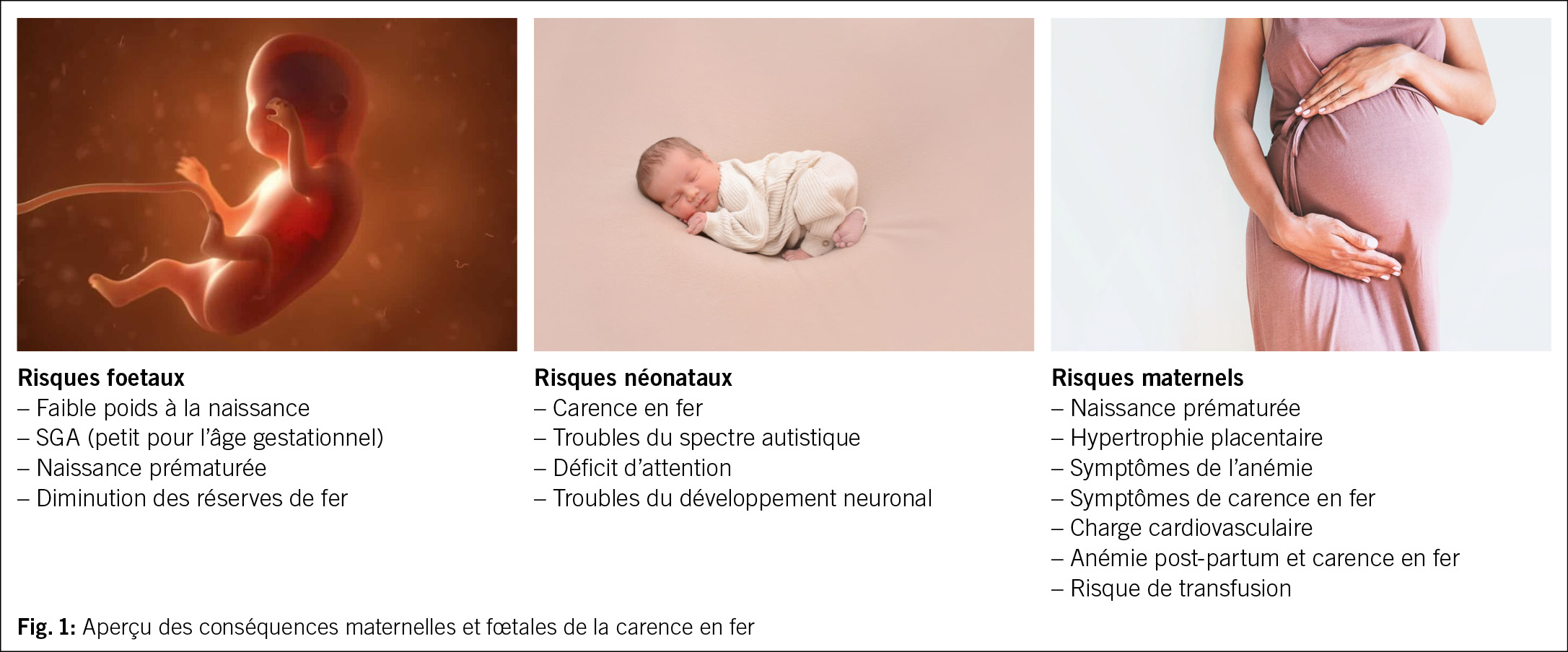
En outre, le risque de travail prématuré et d’ accouchement prématuré est accru (9). L’ anémie ferriprive péri-partum est associée à un risque accru de dépression post-partum, de baisse de la qualité de vie, d’ anémie post-partum et de transfusion sanguine (21). Il est prouvé qu’ une carence en fer sévère augmente la morbidité fœtale et néonatale. Les connaissances issues de modèles animaux indiquent que la carence en fer pendant les phases critiques du développement fœtal entraîne des modifications du métabolisme cérébral, de la neurotransmission, de l’ épigénétique et de la myélinisation pendant les phases critiques du développement fœtal, qui se répercutent chez le nouveau-né. Des études cliniques récentes montrent que ces conséquences se produisent également chez l’ homme et qu’ il existe par exemple un lien entre la carence en fer et les troubles du spectre autistique et le déficit d’ attention chez les adolescents. La carence en fer maternelle entraîne de faibles réserves de fer fœtal et néonatal, avec les conséquences que cela implique (14, 15, 18, 27–31) (Fig. 1).
Screening de la carence en fer
Il n’ existe pas de consensus sur les protocoles de dépistage ou sur la réalisation systématique d’ un dépistage de la carence en fer durant la grossesse. Seules quelques organisations soutiennent le dépistage de la carence en fer isolée, car il existe peu d’ études démontrant une amélioration du risque par un traitement. En Angleterre, on recommande depuis peu un dépistage basé sur les risques, chez les femmes ayant des antécédents d’ anémie, les multipares, les grossesses multiples, les intervalles de grossesse courts, les végétariennes, les femmes présentant un risque élevé d’ hémorragie à la naissance et les femmes qui refusent les transfusions sanguines. L’ American College of OBGYN (ACOG) recommande un dépistage de l’ anémie et une supplémentation générale en fer chez les femmes enceintes. Selon l’ ACOG, le test de ferritine ne doit être effectué qu’ en cas d’ anémie, avec une valeur seuil de < 30 µg/L (OMS < 15 µg/L!) (Practice Bulletin 233, août 2021). Dans la lettre d’ experts de la SSGO (n° 77), nous recommandons le dosage de l’ hémoglobine et de la ferritine au cours du premier trimestre et aux alentours de 24–28 semaines de grossesse pour détecter les carences en fer et l’ anémie chez les femmes enceintes.
Traitement
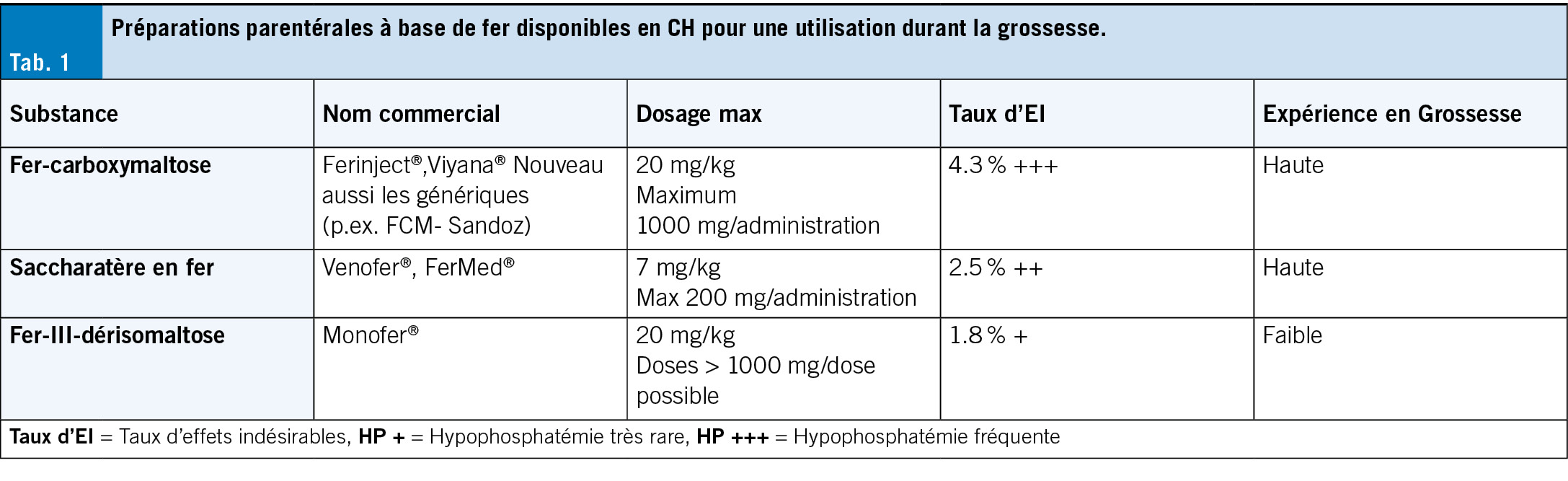
Plusieurs lignes directrices nationales recommandent une supplémentation orale générale en fer chez les femmes enceintes (ACOG, Centers of Disease Control, OMS). Celle-ci peut se faire quotidiennement ou en alternance tous les deux jours. Il a été démontré qu’ une prise orale de fer tous les deux jours augmente l’ absorption du fer tout en réduisant le taux d’ effets secondaires indésirables (4, 22). Il convient de choisir la dose de fer la plus faible possible par voie orale (environ 30 mg de fer élémentaire/dose), car les doses élevées entraînent l’ arrêt du traitement chez jusqu’ à 70 % des femmes, en raison des effets secondaires gastro-intestinaux. Il convient de noter que le fer oral constitue la seule option de traitement au premier trimestre. Il existe de nombreuses préparations orales à base de fer; en règle générale, les sels de fer II présentent un taux d’EI (effets indésirables) plus élevé que les complexes de fer III, par exemple. Selon des études, les bisglycinates de fer (composé amino-ferrique) présentent une bonne absorption et une bonne efficacité avec un faible taux d’EI (16, 25). À partir du deuxième trimestre, il existe des préparations intraveineuses à base de fer pour le traitement de l’anémie ferriprive, qui se sont avérées sûres et efficaces durant la grossesse. Contrairement au fer oral, seul le fer intraveineux convient au traitement des carences en fer et des anémies graves, en particulier lorsque nous souhaitons une efficacité à court terme (24, 25, 42–49). Les doses correspondent à celles utilisées chez les femmes non enceintes. Dans la plupart des cas, en Suisse, il est aujourd’hui possible d’utiliser des doses unitaires élevées, ce qui, en raison de la simplicité d’utilisation et de l’efficacité, entraîne également une grande satisfaction des patientes. Les préparations parentérales à base de fer les plus utilisées dans le monde sont le saccharate de fer, le dextran de fer de faible poids moléculaire (LMWD, Cave: PAS le dextran de poids moléculaire élevé!), le fer-carboxy-maltose (FCM), le ferumoxytol et le fer-III-dérisomaltose (24, 25). En ce qui concerne les réactions allergiques et les autres effets indésirables, les préparations sont comparables. Dans les études comparatives entre le fer parentéral et le fer oral, le taux d’EI est généralement plus élevé pour les préparations orales, principalement en raison des effets secondaires gastro-intestinaux. Selon les études disponibles, le fer-carboxymaltose présente le taux le plus élevé d’hypophosphatémie induite après perfusion, bien que les hypophosphatémies graves soient rares après des doses uniques. Dans une étude récemment publiée par le service d’obstétrique de l’Université de Genève, 3/22 femmes enceintes ont présenté une hypophosphatémie après carboxymaltose ferrique contre 1/22 femmes enceintes sous fer oral (13 contre 4 %). La différence n’ était pas significative et les nouveau-nés n’ ont pas présenté d’ hypophosphatémie dans le groupe carboxymaltose ferrique (49). Les préparations recommandées et les plus utilisées en Suisse sont présentées dans le Tab. 1. En cas de thérapie ferrique i.v., les directives recommandées par SWISSMEDIC doivent être respectées en général et en particulier durant la grossesse. De même, il convient de tenir compte des contre-indications telles que le premier trimestre, une infection bactérienne aiguë et un status après une anaphylaxie ou une réaction allergique grave après l’ administration de fer i.v. On estime que le risque de réaction anaphylactique est inférieur à 1 : 1000 avec les nouvelles préparations à base de fer.
Les indications pour l’ utilisation de fer parentéral sont l’ absence de réponse ou une réponse insuffisante au fer oral (augmentation de l’ Hb < 10G/L dans les 14 jours), l’ intolérance et la non-compliance à la prise de fer par voie orale, l’ absorption perturbée du fer (interventions bariatriques, maladies intestinales chroniques, maladie cœliaque), l’ anémie sévère pré-existante ou évolutive (surtout < < 90 G/L), la nécessité de corriger rapidement et efficacement l’ anémie en cas de facteurs de risque chez la femme enceinte (placenta praevia, risque hémorragique élevé, troubles de la coagulation, refus de sang étranger, status après atonie, etc.) (42, 43, 48).
Les préparations parentérales à base de fer sont également utilisées de manière standard en Suisse dans le post-partum, principalement pour traiter l’ anémie post-partum (Hb < 100G/L).
C. Breymann donne des conférences et des formations pour CLS-Vifor Suisse et CLS-Vifor International et Pierre Fabre/ Robapharm Suisse. Il participe également à des publications sur les préparations à base de fer concernées
1. WHO/UNICEF/UNU. Iron deficiency anaemia: assessment, prevention and control, a guide for programme managers. World Health Organization Geneva Switzerland. 2001. WHO/NHD/01.3. In.
2. Lee AI, Okam MM. Anemia in pregnancy. Hematol Oncol Clin North Am. 2011;25(2):241–259, vii. [PubMed: 21444028] Murray C, Lopez AD. Global and regional cause-of-death patterns in 1990. Bulletin of the World Health Organization. 1994;72(3):447.
3. Osungbade KO, Oladunjoye AO. Preventive treatments of iron deficiency anaemia in pregnancy: a review of their effectiveness and implications for health system strengthening. J Pregnancy. 2012;2012:454601.
4. Zamani AR, Farajzadegan Z, Ghahiri A, KHADEMLOU M, Golshiri P. Effectiveness of twice weekly iron supplementation compared with daily regimen in reducing anemia and iron deficiency during pregnancy: a randomized trial in Iran. 2008.
5. Daru J, Allotey J, Peña-Rosas JP, Khan KS. Serum ferritin thresholds for the diagnosis of iron deficiency in pregnancy: a systematic review. Transfus Med. 2017;27(3):167–174.
6. Tang G, Lausman A, Abdulrehman J, et al. Prevalence of iron deficiency and iron deficiency anemia during pregnancy: a single centre Canadian study. Blood. 2019;134:3389.
7. Barton JC, Wiener HH, Acton RT, et al. Prevalence of iron deficiency in 62,685 women of seven race/ethnicity groups: The HEIRS Study. PLoS One. 2020;15(4):e0232125.
8. Campbell R, Wang H, Ahmed R. Risk Factors Contributing to Racial/Ethnic Disparities in Iron Deficiency in US Women. Current Developments in Nutrition. 2021;5(Supplement_2):725–725.
9. Ren A, Wang J, Ye RW, Li S, Liu JM, Li Z. Low first-trimester hemoglobin and low birth weight, preterm birth and small for gestational age newborns. Int J Gynaecol Obstet. 2007;98(2):124–128.
10. Read AJ, Waljee AK, Sussman JB, et al. Testing Practices, Interpretation, and Diagnostic Evaluation of Iron Deficiency Anemia by US Primary Care Physicians. JAMA Network Open. 2021;4(10):e2127827–e2127827.
11. Auerbach M, Abernathy J, Juul S, Short V, Derman R. Prevalence of iron deficiency in first trimester, nonanemic pregnant women. J Matern Fetal Neonatal Med. 2021;34(6):1002–1005.
12. Jaime-Perez JC, Herrera-Garza JL, Gomez-Almaguer D. Sub-optimal fetal iron acquisition under a maternal environment. Arch Med Res. 2005;36(5):598–602.
13. Scholl TO. Iron status during pregnancy: setting the stage for mother and infant. Am J Clin Nutr. 2005;81(5):1218s–1222s.
14. Kilbride J, Baker TG, Parapia LA, Khoury SA, Shuqaidef SW, Jerwood D. Anaemia during pregnancy as a risk factor for iron-deficiency anaemia in infancy: a case-control study in Jordan. Int J Epidemiol. 1999;28(3):461–468.
15. Kelly AM, MacDonald DJ, McDougall AN. Observations on maternal and fetal ferritin concentrations at term. Br J Obstet Gynaecol. 1978;85(5):338–343.
16. Elstrott B, Khan L, Olson S, Raghunathan V, DeLoughery T, Shatzel JJ. The role of iron repletion in adult iron deficiency anemia and other diseases. Eur J Haematol. 2020;104(3):153–161.
17. Bothwell TH. Iron requirements in pregnancy and strategies to meet them. Am J Clin Nutr. 2000;72(1 Suppl):257s–264s.
18. Colomer J, Colomer C, Gutierrez D, et al. Anaemia during pregnancy as a risk factor for infant iron deficiency: report from the Valencia Infant Anaemia Cohort (VIAC) study. Paediatr Perinat Epidemiol. 1990;4(2):196–204.
19. Gambling L, Danzeisen R, Gair S, et al. Effect of iron deficiency on placental transfer of iron and expression of iron transport proteins in vivo and in vitro. Biochem J. 2001;356(Pt 3):883–889. [PubMed: 11389698]
20. Soares NN, Mattar R, Camano L, Torloni MR. Iron deficiency anemia and iron stores in adultand adolescent women in pregnancy. Acta Obstet Gynecol Scand. 2010;89(3):343–349.
21. Juul SE, Derman RJ, Auerbach M. Perinatal iron deficiency: implications for mothers and infants. Neonatology. 2019;115(3):269–274.
22. Leonard AJ, Chalmers KA, Collins CE, Patterson AJ. Comparison of two doses of elemental iron in the treatment of latent iron deficiency: efficacy, side effects and blinding capabilities. Nutrients. 2014;6(4):1394–1405.
23. Yu X, Shan Z, Li C, et al. Iron deficiency, an independent risk factor for isolated hypothyroxinemia in pregnant and nonpregnant women of childbearing age in China. The Journal of Clinical Endocrinology & Metabolism. 2015;100(4):1594–1601.
24. Govindappagari S, Newman R, Burwick R. Iron-deficiency anemia in pregnancy and the role of intravenous iron. Contemporary OB/GYN Journal. 2021;66(07).
25. Auerbach M, James SE, Nicoletti M, et al. Results of the First American Prospective Study of Intravenous Iron in Oral Iron-Intolerant Iron-Deficient Gravidas. Am J Med. 2017;130(12):1402– 1407.
26. Zimmermann MB, Burgi H, Hurrell RF. Iron deficiency predicts poor maternal thyroid status during pregnancy. J Clin Endocrinol Metab. 2007;92(9):3436–3440.
27. Tran PV, Fretham SJ, Carlson ES, Georgieff MK. Long-term reduction of hippocampal brain- derived neurotrophic factor activity after fetal-neonatal iron deficiency in adult rats. Pediatr Res. 2009;65(5):493–498.
28. Tamura T, Goldenberg RL, Hou J, et al. Cord serum ferritin concentrations and mental and psychomotor development of children at five years of age. J Pediatr. 2002;140(2):165–170.
29. Lozoff B, Beard J, Connor J, Barbara F, Georgieff M, Schallert T. Long-lasting neural and behavioral effects of iron deficiency in infancy. Nutr Rev. 2006;64(5 Pt 2):S34–43; discussion S72–91.
30. McArdle HJ, Gambling L, Kennedy C. Iron deficiency during pregnancy: the consequences for placental function and fetal outcome. Proceedings of the Nutrition Society. 2014;73(1):9–15.
31. Wiegersma AM, Dalman C, Lee BK, Karlsson H, Gardner RM. Association of prenatal maternal anemia with neurodevelopmental disorders. JAMA psychiatry. 2019;76(12):1294–1304.
32. Shao J, Lou J, Rao R, et al. Maternal serum ferritin concentration is positively associated with newborn iron stores in women with low ferritin status in late pregnancy. J Nutr. 2012;142(11):2004–2009.
33. Moretti D, Goede JS, Zeder C, et al. Oral iron supplements increase hepcidin and decrease iron absorption from daily or twice-daily doses in iron-depleted young women. Blood. 2015;126(17):1981–1989.
34. Stoffel NU, von Siebenthal HK, Moretti D, Zimmermann MB. Oral iron supplementation in iron- deficient women: How much and how often? Molecular Aspects of Medicine. 2020;75:100865.
35. Tolkien Z, Stecher L, Mander AP, Pereira DI, Powell JJ. Ferrous sulfate supplementation causes significant gastrointestinal side-effects in adults: a systematic review and meta-analysis. PloS one. 2015;10(2):e0117383.
36. Neogi SB, Devasenapathy N, Singh R, et al. Safety and effectiveness of intravenous iron sucrose versus standard oral iron therapy in pregnant women with moderate-to-severe anaemia in India: a multicentre, open-label, phase 3, randomised, controlled trial. Lancet Glob Health. 2019;7(12):e1706–e1716.
37. Wong L, Smith S, Gilstrop M, et al. Safety and efficacy of rapid (1,000 mg in 1 hr) intravenous iron dextran for treatment of maternal iron deficient anemia of pregnancy. Am J Hematol. 2016;91(6):590–593.
38. Glaspy JA, Lim-Watson MZ, Libre MA, et al. Hypophosphatemia Associated with Intravenous Iron Therapies for Iron Deficiency Anemia: A Systematic Literature Review. Ther Clin Risk Manag. 2020;16:245–259.
39. Wolf M, Rubin J, Achebe M, et al. Effects of Iron Isomaltoside vs Ferric Carboxymaltose on Hypophosphatemia in Iron-Deficiency Anemia: Two Randomized Clinical Trials. JAMA. 2020;323(5):432–443
40. Froessler B, Collingwood J, Hodyl NA, Dekker G. Intravenous ferric carboxymaltose for anaemia in pregnancy. BMC Pregnancy and Childbirth. 2014;14(1):115.
41. Jose A, Mahey R, Sharma JB, et al. Comparison of ferric Carboxymaltose and iron sucrose complex for treatment of iron deficiency anemia in pregnancy- randomised controlled trial. BMC Pregnancy and Childbirth. 2019;19(1):54.
42. Kant S, Haldar P, Malhotra S, Kaur R, Rath R, Jacob OM. Intravenous ferric carboxymaltose rapidly increases haemoglobin and serum ferritin among pregnant females with moderate-to- severe anaemia: A single-arm, open-label trial. Natl Med J India. 2020;33(6):324–328.
43. Froessler B, Gajic T, Dekker G, Hodyl NA. Treatment of iron deficiency and iron deficiency anemia with intravenous ferric carboxymaltose in pregnancy. Arch Gynecol Obstet. 2018;298(1):75–82.
44. Karki NR, Auerbach M. Single total dose infusion of ferumoxytol (1020 mg in 30 minutes) is an improved method of administration of intravenous iron. Am J Hematol. 2019;94(9):E229–e231.
45. Khan H, May P, Kuo E, et al. Safety and efficacy of a single total dose infusion (1020 mg) of ferumoxytol. Ther Adv Hematol. 2021;12:20406207211006022.
46. Hansen R, Sommer VM, Pinborg A, et al. Intravenous ferric derisomaltose versus oral iron for persistent iron deficient pregnant women: a randomised controlled trial. Arch Gynecol Obstet. 2022.
47. Holm C, Thomsen LL, Norgaard A, Langhoff-Roos J. Single-dose intravenous iron infusion or oral iron for treatment of fatigue after postpartum haemorrhage: a randomized controlled trial. Vox Sang. 2017;112(3):219–228.
48. Daniilidis A, Panteleris N, Vlachaki E, Breymann C, Assimakopoulos E. Safety and efficacy of intravenous iron administration for uterine bleeding or postpartum anaemia: a narrative review. J Obstet Gynaecol. 2018;38(4):443–447. [
49. Fanny Schumacher 1, Francisca Barcos-Munoz 2, Margot Kunckler 1, Nicolas Vuilleumier 3 4, Begoña Martinez de Tejada. Newborn phosphocalcic metabolism after intravenous iron administration during pregnancy. J Matern Fetal Neonatal Med . 2024 Dec;37(1):2320671.
Présentation lors du 27e colloque de formation continue du Collège de Médecine de Premier Recours (CMPR) en collaboration avec la Clinical Skills Academy (CSA)
L’ostéoporose reste une maladie chronique majeure qui entraîne des fractures de fragilité aux conséquences médicales, sociales et économiques considérables.
Pr Serge Ferrari
Pr Serge Ferrari, médecin-chef du service des maladies osseuses, Hôpitaux universitaires de Genève (HUG).
Épidémiologie
• 82 000 nouvelles fractures de fragilité en Suisse en 2019.
• Cela correspond à:
– 226 fractures par jour
– 9.4 fractures par heure
• Coûts
– Invalidité due aux séquelles à long terme: 746 millions d’euros
– Coûts directs liés aux fractures: 2.62 milliards d’euros
• Prévisions: augmentation de 37.5 % des fractures d’ici 2034.
Diagnostic: au-delà de la densité osseuse
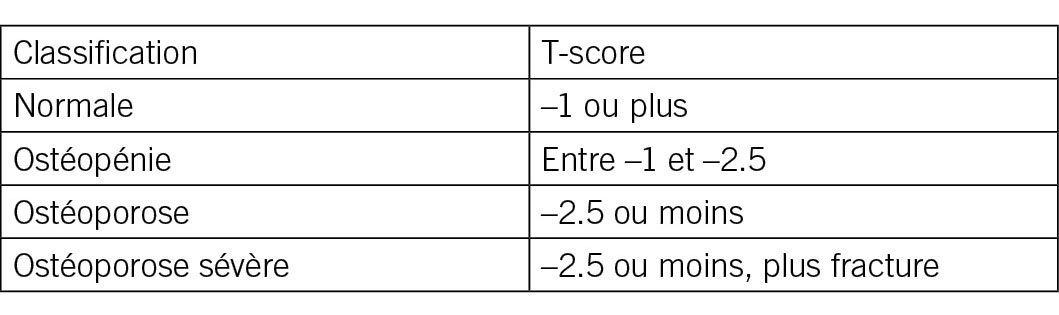
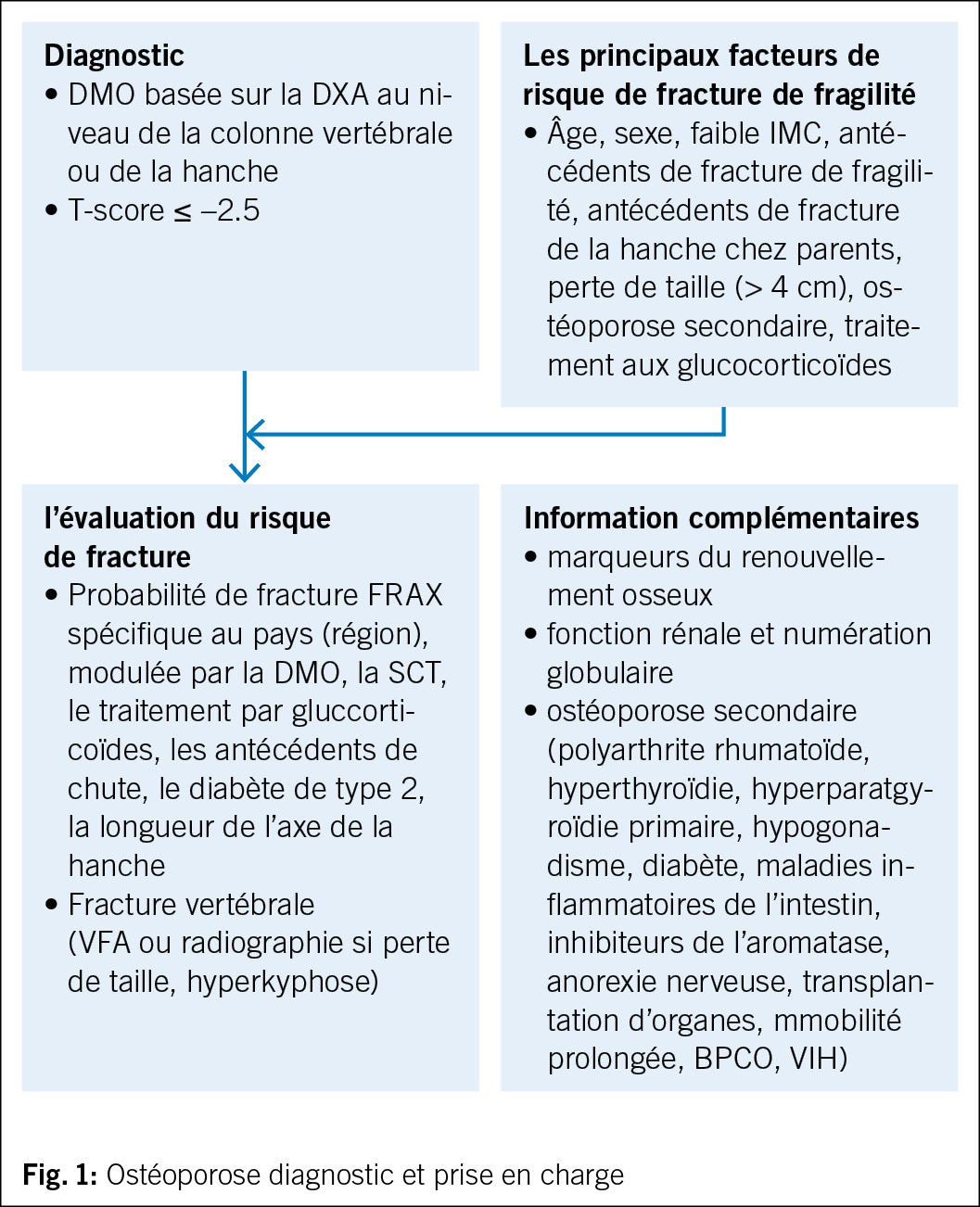
La densitométrie osseuse par DXA, réalisée au rachis lombaire et à la hanche, demeure l’examen de référence. Un T-score ≤ –2.5 définit une ostéoporose manifeste. Toutefois, le Pr Ferrari souligne que la densité minérale osseuse (DMO) ne suffit pas à elle seule pour évaluer le risque de fracture.
L’outil FRAX, adapté au contexte suisse, permet d’estimer la probabilité de fracture à dix ans, en intégrant des facteurs tels que la corticothérapie prolongée, les antécédents de chute, le diabète de type 2 ou la longueur du col fémoral. À côté de ces paramètres, d’autres facteurs de risque demeurent déterminants: âge avancé, sexe féminin, faible indice de masse corporelle, antécédents familiaux de fracture de hanche, consommation d’alcool et tabac, ainsi que certaines pathologies chroniques (polyarthrite rhumatoïde, hyperthyroïdie, maladies inflammatoires de l’intestin).
Cette approche combinée permet une stratification du risque plus fine et conditionne l’indication thérapeutique.
Test de Densité Osseuse
Cas clinique
Patiente: assistante de direction âgée de 55 ans – Antécédents familiaux: mère victime d’une fracture du col du fémur à l’âge de 66 ans après un traumatisme mineur. – Ménopause: depuis 4 ans, pas de traitement hormonal substitutif (THS). – IMC: 48 kg pour 1.56 m → insuffisance pondérale. – Tabagisme: environ 10 cigarettes/jour. – Clinique: aucune autre maladie ou traitement antérieur.
Densitométrie (DXA)
• T-score LOM: –2.1
• T-score hanche totale: –2.0
• T-score col du fémur: –2.8
• Diagnostic: ostéoporose manifeste (score T ≤ –2.5)
• Risque de fracture: élevé
Vous traitez?
La Société suisse contre l’ostéoporose recommande de commencer dès que possible un traitement contre l’ostéoporose chez les personnes âgées ayant récemment subi une fracture de fragilité, l’évaluation clinique déterminant la meilleure façon d’appliquer les directives de traitement dans chaque cas.
Avec les anti-résorbeurs on obtient un gain de DMO à long terme. Le denosumab est plus efficace que l’acide zolédronique et ce dernier est plus efficace que l’alendronate.
La durée du traitement est déterminée en fonction de la DMO de base et de la présence (absence) de fractures et selon évaluation DMO (tous les 2 ans):
RLX jusqu’ à 10 ans, CAVE: perte accélérée DMO à l’arrêt
BPs: jusqu’à 5 ans, avec l’effet résiduel de maintien partiel DMO à l’arrêt
Denosumab: jusqu’à 10 ans et + selon le cas. CAVE perte accélérée DMO à l’arrêt.
Un traitement à long terme par le dénosumab peut être envisagé pour les patients à haut risque de fracture déjà traités par le dénosumab, compte tenu du profil favorable d’efficacité et de sécurité. En cas d’arrêt du dénosumab, un traitement antirésorptif alternatif (zolendronate) doit être initié 6 mois après la dernière injection de dénosumab. L’évaluation des marqueurs du renouvellement osseux peut aider à définir le régime optimal. Dix ans après le début d’une étude Bolland MJ et al NEJM 2025), le zolédronate administré au début de l’étude et après 5 ans s’est avéré efficace pour prévenir les fractures vertébrales morphométriques chez les femmes ménopausées précoces.